

How MetaClaw and Ollama Make OpenClaw Smarter?
OpenClaw Error Fixer
Paste any OpenClaw error and get the exact fix instantly — cause, steps, copy-ready commands, and related guides.
OpenClaw is still ruling the AI world. It is definitely smart, but every session it starts from zero. Same mistakes, same patterns, no growth.
That is where this new tool MetaClaw is trying to help. It lets you talk to your agent normally in text and it gets better automatically. You do not need any complex setup and it requires only two to three commands.
How MetaClaw and Ollama Make OpenClaw Smarter?
MetaClaw sits between OpenClaw and your LLM as a proxy. It intercepts every conversation, injects the most relevant skills into the system prompt at every turn, and after each session automatically distills what happened into new skills using your own LLM. The skill library grows with your usage.
Most agents are stateless by design and that is a very important point. Every conversation starts fresh. You fix the same issues repeatedly, explain your preferences over and over, and the agent never carries forward what it learned.
Even with memory tools, the agent is only recalling facts. It is not actually improving its behavior. MetaClaw is trying to be different here.
If you need a quick refresher on pairing OpenClaw with Ollama, check this guide to the OpenClaw and Ollama model setup: OpenClaw with Ollama.
Setup and environment
I am on Ubuntu with OpenClaw already installed and integrated with my Ollama-based models. I am also using a slightly older OpenClaw version. My GPU is an Nvidia RTX 6000 with 48 GB of VRAM.
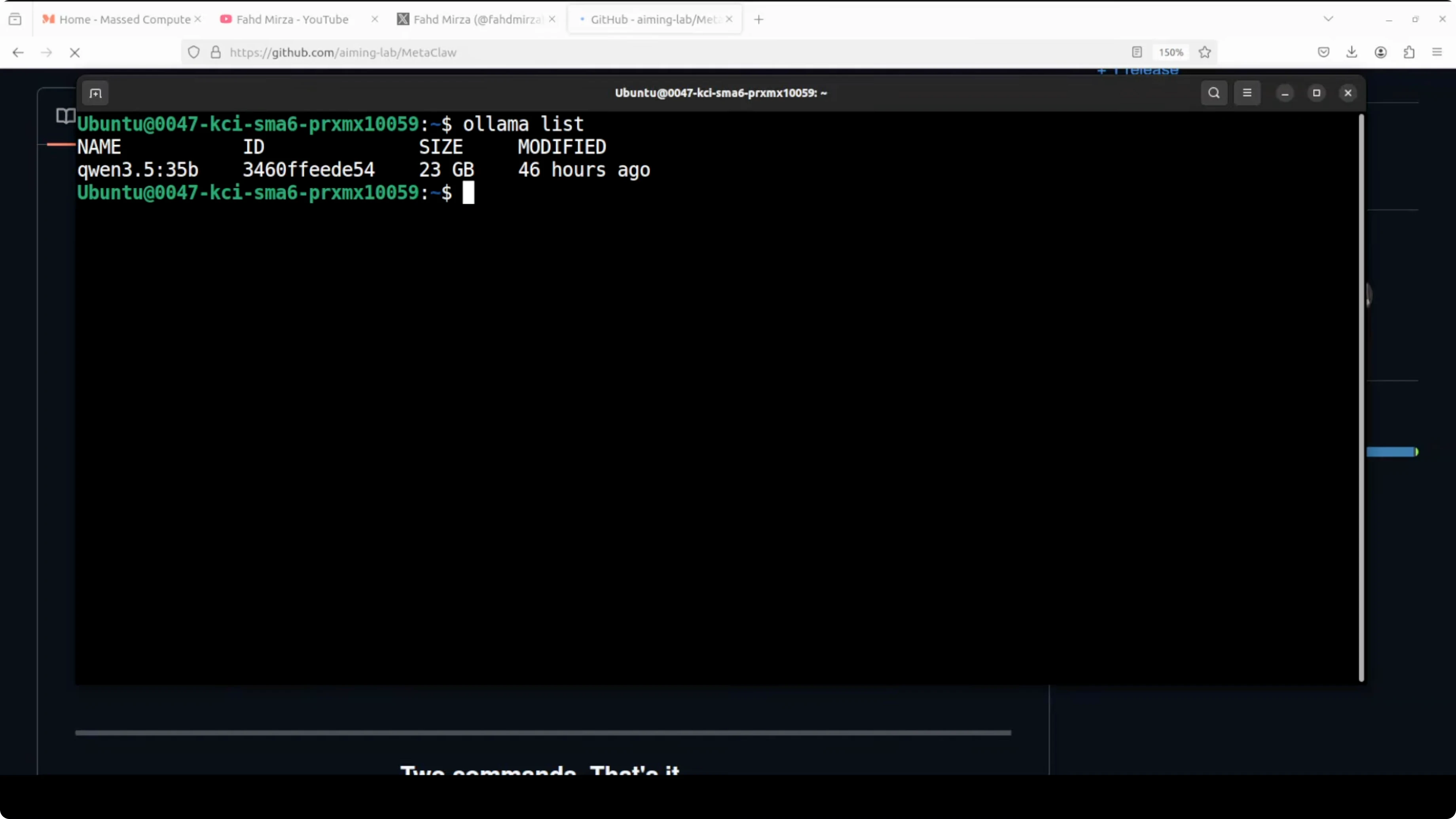
If you plan to run Qwen 3.5 32B locally via Ollama with OpenClaw, this step-by-step helps a lot: run Qwen 3.5 with OpenClaw using Ollama. It keeps everything local and saves you from API costs. That is what I am using here.
##Install MetaClaw locally
Clone the repo. Run prerequisites from the repo root. Run the guided setup.
git clone https://github.com/aiming-lab/MetaClaw.git
cd MetaClaw
pip install -r requirements.txt
metaclaw setup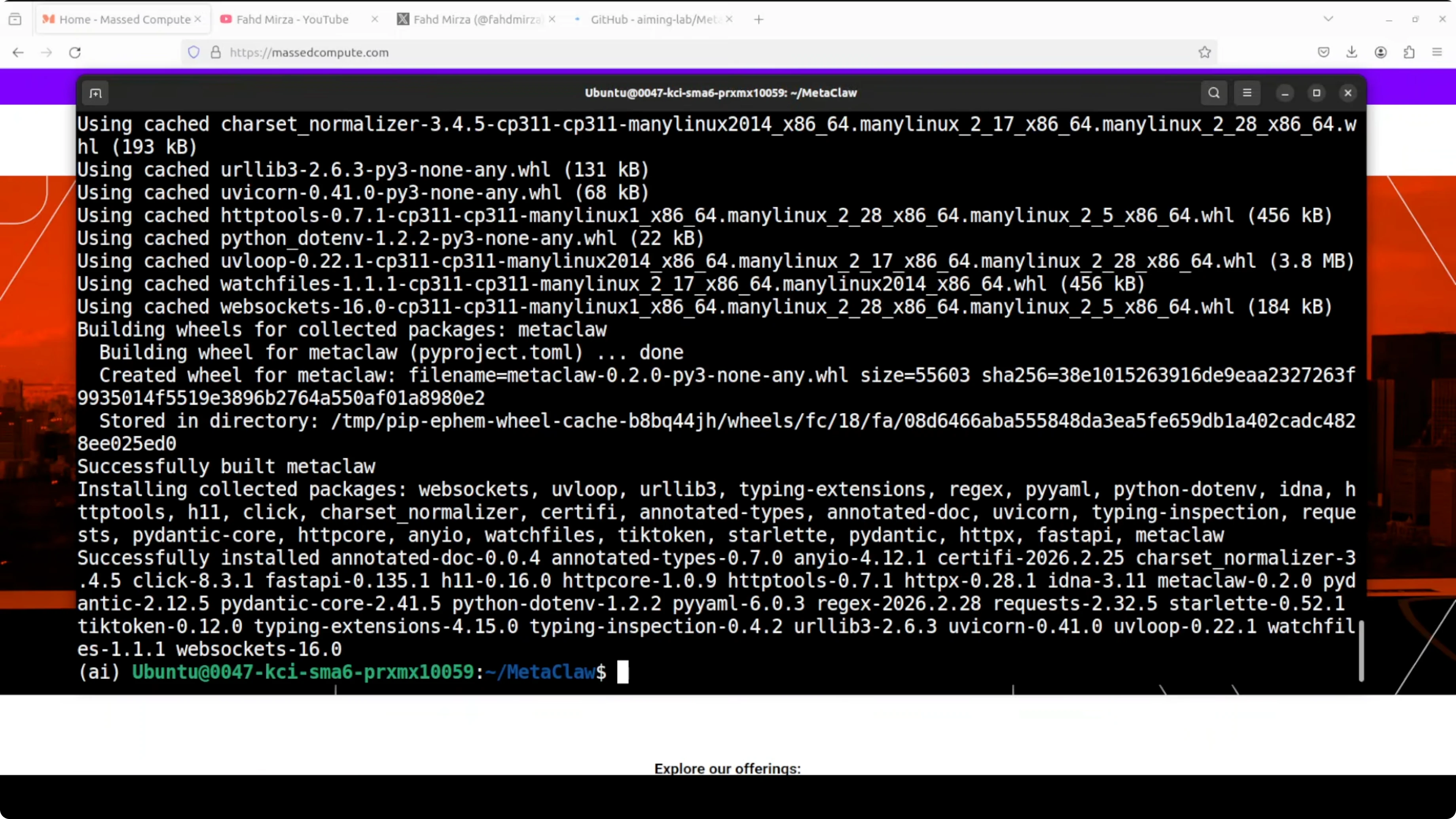
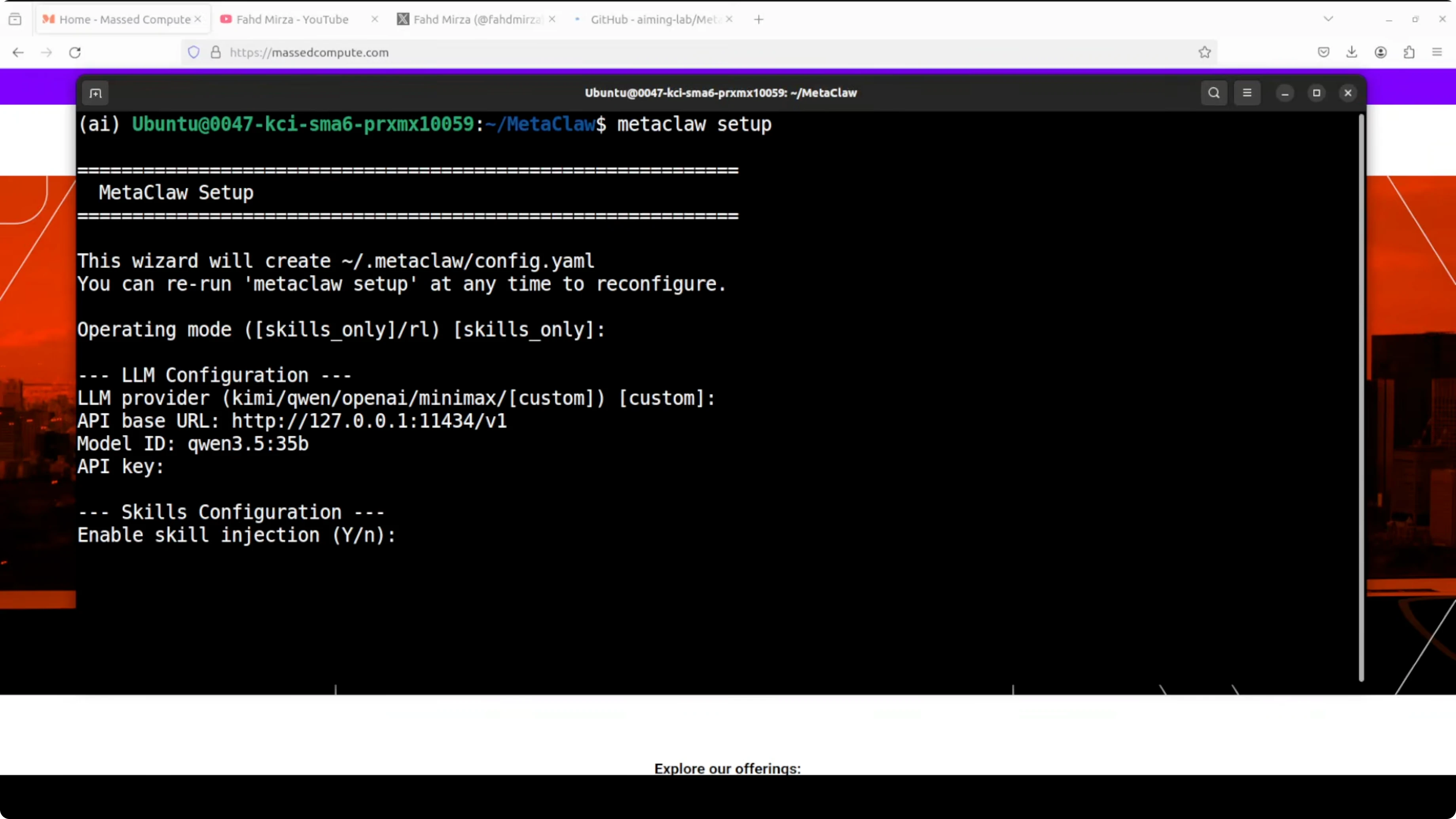
During setup, pick the mode where the agent injects and learns skills from conversations. No training is involved in this mode and that is what we want here. Skip the RL mode that fine-tunes model weights in real time because it needs a paid API.

For the LLM provider, stick with a custom base URL pointing to your Ollama instance. The default Ollama API base URL is http://localhost:11434 and that is what I use. For the model ID, paste your local model, for example qwen2.5-32b-instruct or llama3.1.
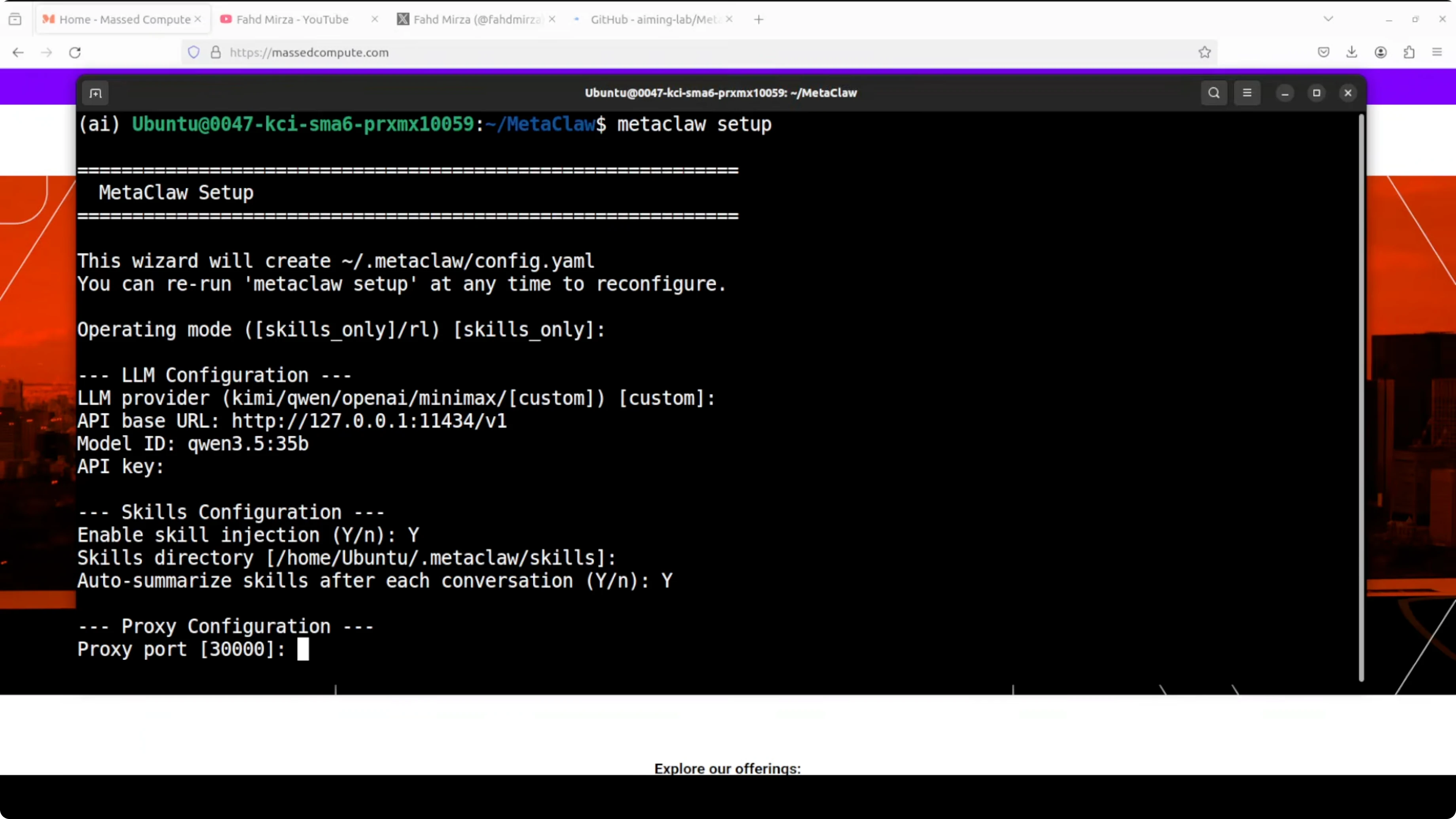
For the API key, any placeholder value is fine because Ollama on localhost does not require it. Enable skill injection so MetaClaw inserts the most relevant skills into the system prompt before every response. Accept the default skills directory and enable auto summarization.
Enable and configure the proxy. Accept the default port shown by the setup, unless you need to change it for your environment. Keep everything local so you do not pay for API calls. Finish the setup and continue.
Start and verify Start MetaClaw. Check status in another terminal. Confirm configuration and model mapping.
metaclaw start
metaclaw status
You should see that the proxy is running and wired into your OpenClaw gateway. MetaClaw will report that it loaded general and task-specific skills from the skill bank. You can also confirm it picked your Ollama model.
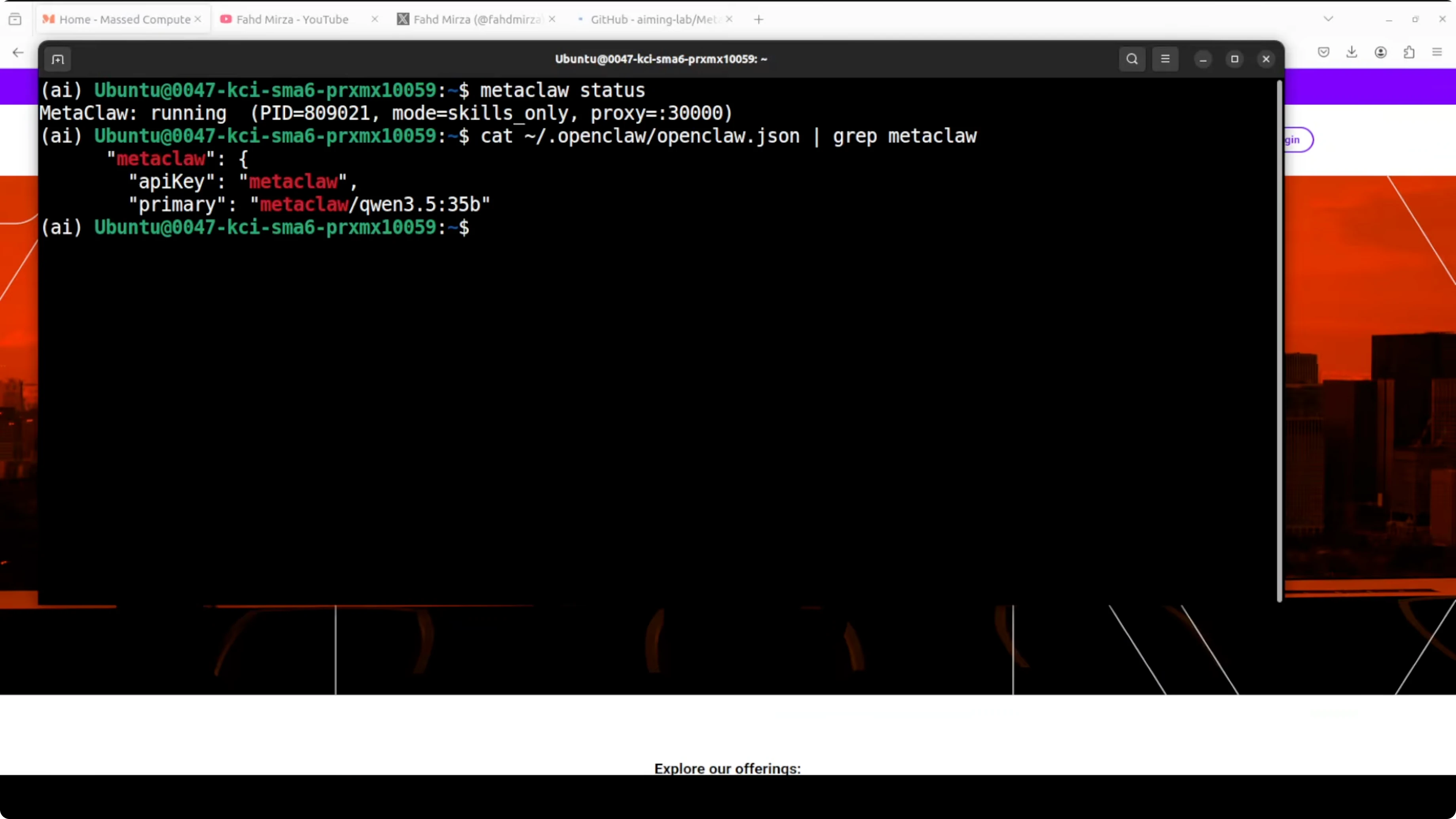
If you like working from a terminal-first workflow with OpenClaw, this quick reference helps: access the Terminal UI for OpenClaw. It is handy for fast checks while you iterate on skills. You can layer MetaClaw beneath it without changing your normal flow.
Skill bank and custom skills
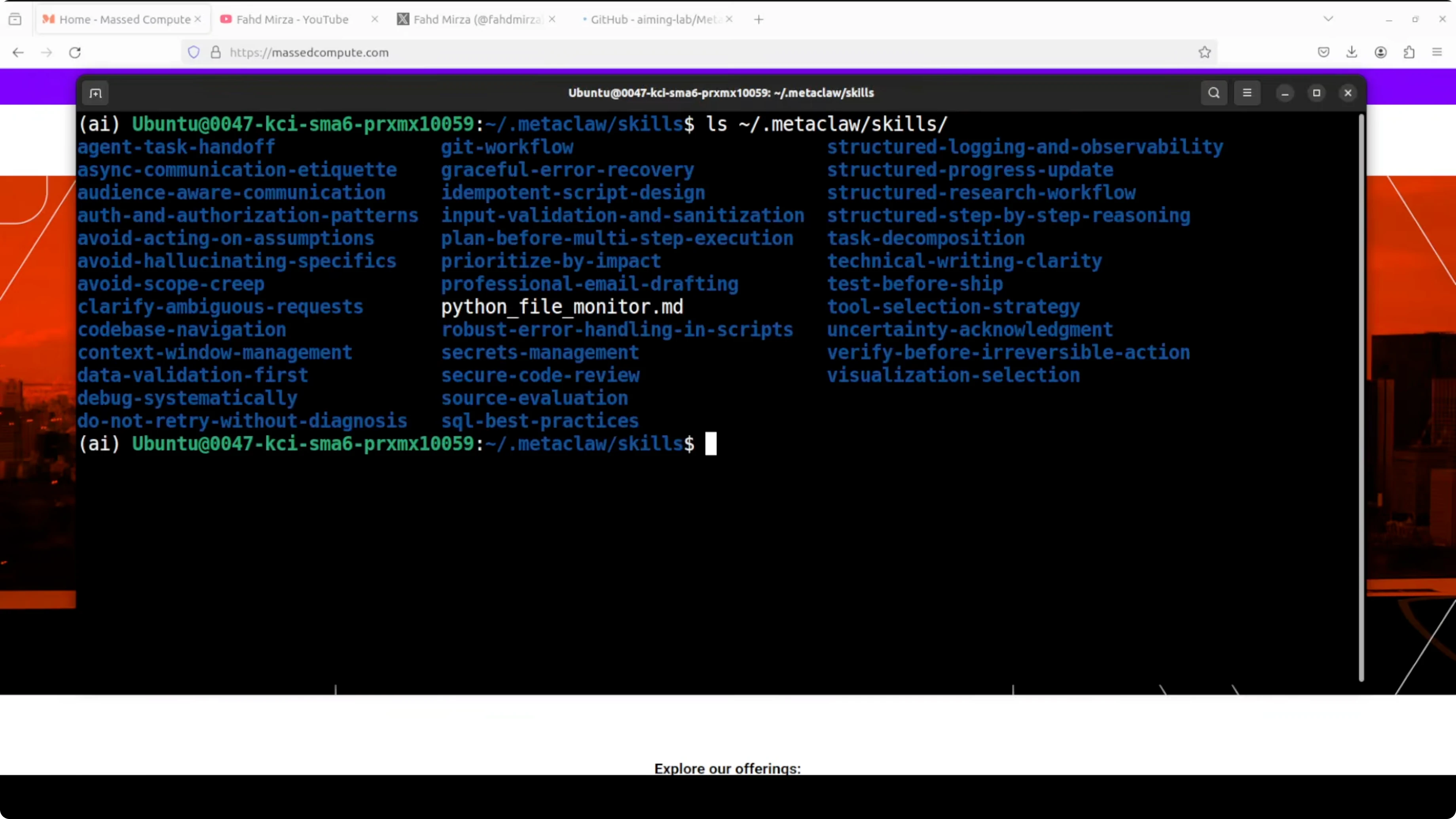
MetaClaw ships with a general skill bank and task-specific skills. You can copy your own skills into the skill bank folder if you already maintain reusable patterns. MetaClaw will consider them during injection and learning.
Once MetaClaw is running, you can use OpenClaw or any other API client as usual. Behind the scenes, MetaClaw injects skills and keeps distilling new ones after each session. That is where the improvement shows up over time.
If you prefer monitoring your agent and projects from a browser, here is a simple way to open the OpenClaw dashboard locally: OpenClaw dashboard access. It pairs nicely with the MetaClaw proxy. You do not need to change your UI habits.
Test it with a real task
Ask the agent to write a Python script that monitors a directory for new files and logs them with a timestamp. MetaClaw will intercept the session and generate a new skill from the exchange. That distilled pattern will be injected automatically next time before the agent starts thinking.
Here is a Python example you can use in your test.
import os
import time
import logging
from datetime import datetime

WATCH_DIR = "/path/to/watch"
LOG_FILE = "file_events.log"

logging.basicConfig(
    filename=LOG_FILE,
    level=logging.INFO,
    format="%(asctime)s - %(message)s",
)

def snapshot(dir_path):
    return {f for f in os.listdir(dir_path) if os.path.isfile(os.path.join(dir_path, f))}

def main():
    if not os.path.isdir(WATCH_DIR):
        raise SystemExit(f"Directory not found: {WATCH_DIR}")

    seen = snapshot(WATCH_DIR)
    logging.info(f"Started watcher for {WATCH_DIR}. Baseline files: {len(seen)}")

    try:
        while True:
            current = snapshot(WATCH_DIR)
            new_files = current - seen
            for fname in sorted(new_files):
                full = os.path.join(WATCH_DIR, fname)
                ts = datetime.now().strftime("%Y-%m-%d %H:%M:%S")
                logging.info(f"New file: {fname} at {ts} (size={os.path.getsize(full)} bytes)")
            seen = current
            time.sleep(2)
    except KeyboardInterrupt:
        logging.info("Watcher stopped.")

if __name__ == "__main__":
    main()
After this run, check the skills directory MetaClaw uses. You will see a new file capturing the distilled pattern from your conversation. That is the reusable skill that gets injected the next time you request anything related to file monitoring.
##Models under Ollama: choices, use cases, and trade-offs
Qwen 3.5 32B is strong on coding, tool use, and structured tasks. It shines for automation, scripting, and agent-style workflows where precise step-by-step output matters. It needs significant VRAM and will be slower on smaller GPUs.
LLaMA family models are versatile and widely available in Ollama. They are good for general reasoning, writing, and mixed chat plus code work. Smaller variants are faster but may miss deeper context on complex tasks.
If you want to explore an alternate OpenClaw fork that plays well with Ollama in local setups, this walkthrough is helpful: Zeroclaw with Ollama. It can be a solid baseline to compare agent behavior under the same MetaClaw proxy. Testing different stacks makes it easy to see where skill injection helps the most.
What to expect after setup
MetaClaw loads a set of general and task-specific skills from the skill bank at startup. It uses your local Ollama models, so you do not pay for API calls. You can access OpenClaw as usual while MetaClaw runs behind the scenes.
You will notice skills and memory-like notes accumulating about your profile, tags, timing, and workspace. That context becomes part of the system prompt at the right moments. It is trying to do a valuable thing instead of just replicating OpenClaw.
Every session that teaches the agent something useful turns into long-term expertise. The more you use it, the sharper it gets. It automatically curates what matters without a manual training pipeline to manage.

Reference and resources
MetaClaw project page and setup details are here: MetaClaw on GitHub. You can track updates, issues, and exact config flags. Keep your local README close while testing.
If you are starting fresh with OpenClaw on Ollama, this quick-start helps you get the pairing right before you add MetaClaw: OpenClaw with Ollama guide. It keeps the foundation stable so the proxy setup goes smoothly.
Final thoughts
MetaClaw wires into OpenClaw as a local proxy, injects the right skills automatically, and distills new ones after each session. If it works correctly, the more you use it, the sharper it gets, and it turns every conversation into your agent's long-term expertise. Pretty nifty idea.
Testing it with coding and workflow tasks shows clear gains where repeated patterns matter. Keeping everything local with Ollama and a capable GPU makes it cost effective. For a deeper OpenClaw setup reference, keep these handy: OpenClaw dashboard setup and terminal access.
Subscribe to our newsletter
Get the latest updates and articles directly in your inbox.

Related Posts

8 Best Claude Code Plugins in 2026 (You Need to Know)
8 Best Claude Code Plugins in 2026 (You Need to Know)

7 Best Claude Code Skills (You Need to Know)
7 Best Claude Code Skills (You Need to Know)
Claude Code Desktop IDE Features (You Need to Know)
Claude Code Desktop IDE Features (You Need to Know)