
Table Of Content
- Opus 4.5 vs GPT-5.1: Which Copywriting Tool Wins - test plan
- Step-by-step setup
- Opus 4.5 vs GPT-5.1: Which Copywriting Tool Wins - PRD challenge
- Opus 4.5 vs GPT-5.1: Which Copywriting Tool Wins - three-email sequence
- Opus 4.5 vs GPT-5.1: Which Copywriting Tool Wins - landing page copy
- Opus 4.5 vs GPT-5.1: Which Copywriting Tool Wins - comparison overview
- Opus 4.5 vs GPT-5.1: Which Copywriting Tool Wins - pros and cons
- Opus 4.5 vs GPT-5.1: Which Copywriting Tool Wins - Opus 4.5
- Opus 4.5 vs GPT-5.1: Which Copywriting Tool Wins - GPT-5.1
- Opus 4.5 vs GPT-5.1: Which Copywriting Tool Wins - use cases
- Opus 4.5 vs GPT-5.1: Which Copywriting Tool Wins - reproduce the test
- Final thoughts
Opus 4.5 vs GPT-5.1: Which Copywriting Tool Wins?
Table Of Content
- Opus 4.5 vs GPT-5.1: Which Copywriting Tool Wins - test plan
- Step-by-step setup
- Opus 4.5 vs GPT-5.1: Which Copywriting Tool Wins - PRD challenge
- Opus 4.5 vs GPT-5.1: Which Copywriting Tool Wins - three-email sequence
- Opus 4.5 vs GPT-5.1: Which Copywriting Tool Wins - landing page copy
- Opus 4.5 vs GPT-5.1: Which Copywriting Tool Wins - comparison overview
- Opus 4.5 vs GPT-5.1: Which Copywriting Tool Wins - pros and cons
- Opus 4.5 vs GPT-5.1: Which Copywriting Tool Wins - Opus 4.5
- Opus 4.5 vs GPT-5.1: Which Copywriting Tool Wins - GPT-5.1
- Opus 4.5 vs GPT-5.1: Which Copywriting Tool Wins - use cases
- Opus 4.5 vs GPT-5.1: Which Copywriting Tool Wins - reproduce the test
- Final thoughts
I put Opus 4.5 head-to-head against GPT-5.1 in a copywriting battle. The goal was to see which model performs best across structured planning and persuasive writing. I used Gemini 3 Pro as a blind judge to score both outputs and pick a winner across three tasks.
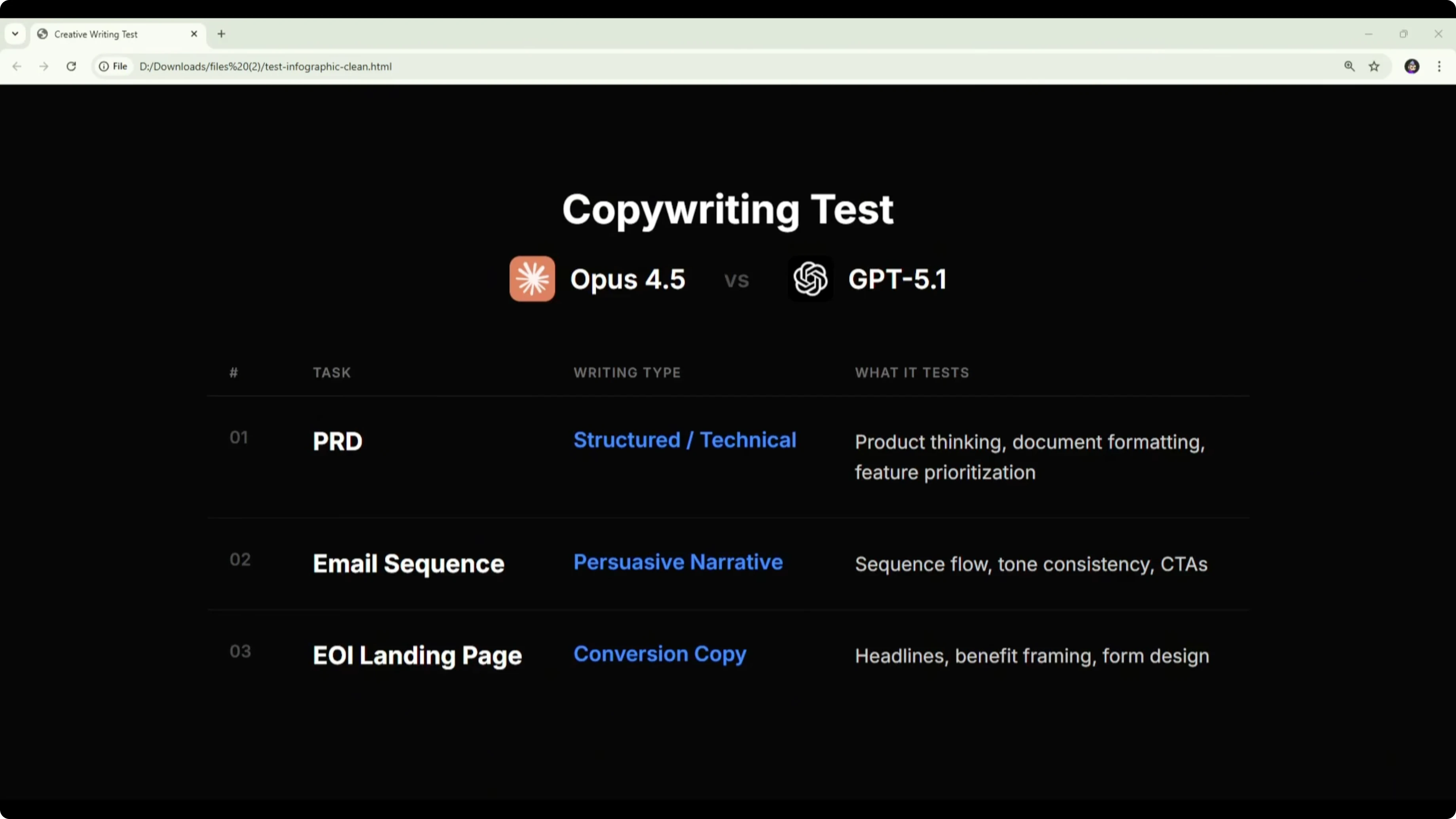
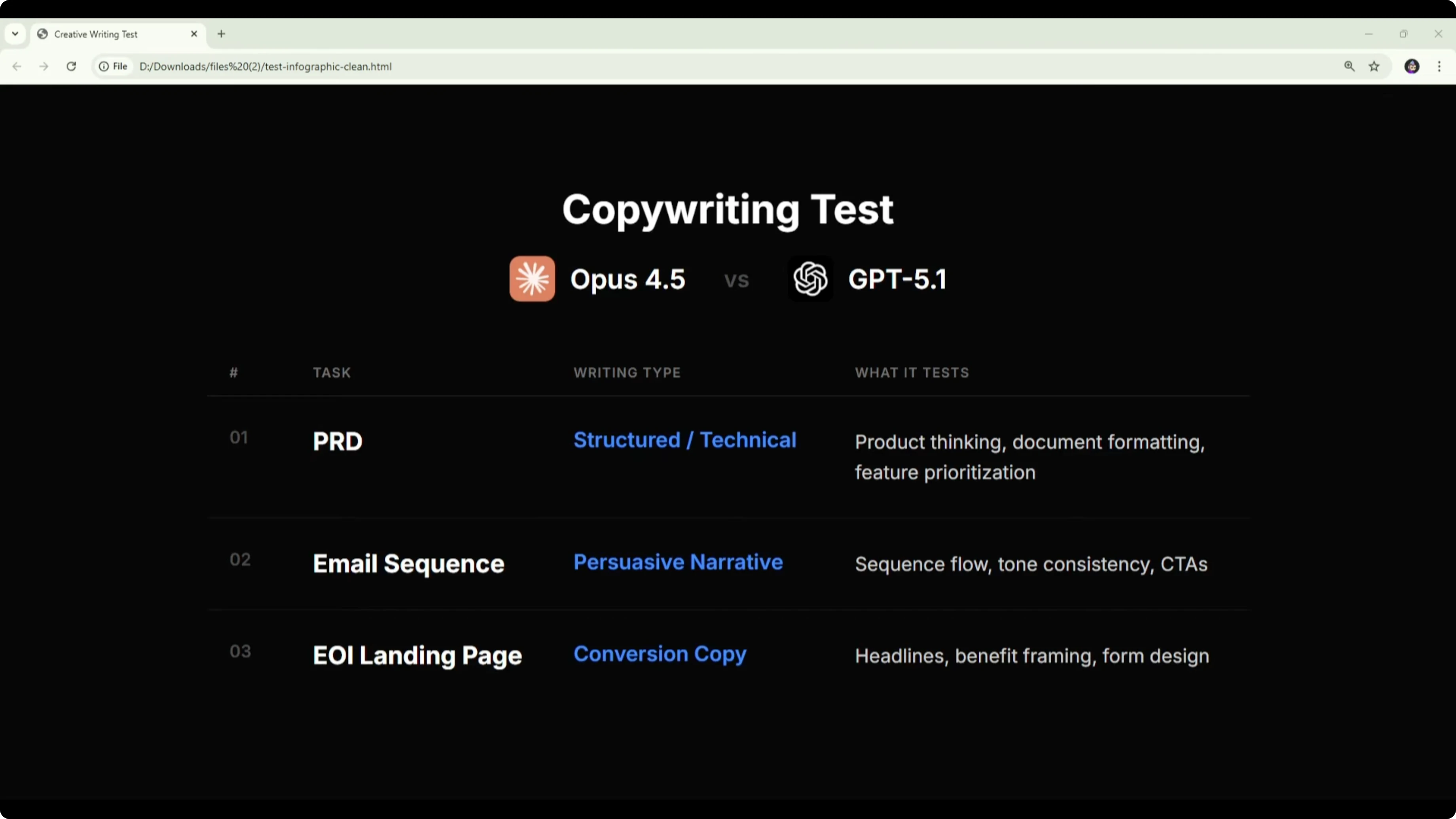
I tested a full PRD, a three-email launch sequence, and landing page copy. That covered structured thinking, tone and flow, and conversion writing. By the end, I had a clear winner for copywriting and content creation tasks.
For a broader benchmark across multiple providers, see this comparison of GLM, Opus, and GPT models: multi-model benchmark.
Opus 4.5 vs GPT-5.1: Which Copywriting Tool Wins - test plan
I asked both models to complete the same three tasks under the same conditions. I kept the briefs open enough to let each model design the solution the way it wanted. Gemini 3 Pro served as a blind judge with anonymized outputs labeled PRDA and PRDB.
I assessed clarity, completeness, tone, and conversion intent. For task two and three, I provided both models the winning PRD as context to ensure parity. The aim was to reduce bias and isolate writing quality and decision making.
Step-by-step setup
Prepare a single prompt for each task with the same requirements for both models.
Run both models with identical context, request markdown outputs, and collect the files.
Anonymize outputs as PRDA and PRDB, then feed both into Gemini 3 Pro for blind scoring.
Record qualitative notes on structure, specificity, calls to action, and conversion angles.
Aggregate the judge’s verdict with your notes to declare a winner per task.
Repeat the process for all tasks before compiling final takeaways.
Opus 4.5 vs GPT-5.1: Which Copywriting Tool Wins - PRD challenge
A product requirements document is the blueprint for an app or product. It covers target users, features, technical requirements, and how everything fits together. If a model can write a solid PRD, it shows it can think through a product end to end and write clearly for development handoff.
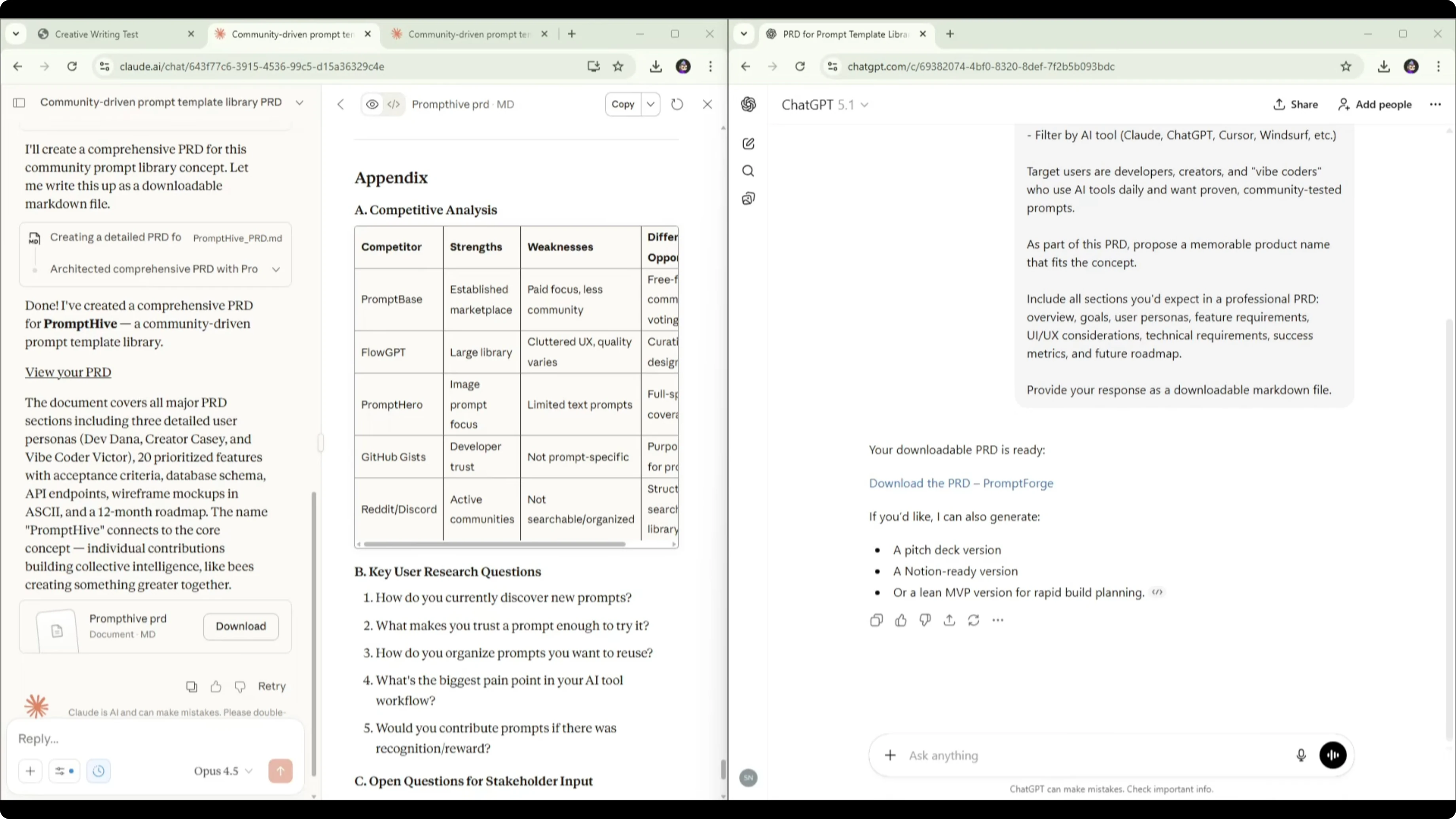
For the brief, I asked both models to write a PRD for a community-driven prompt template library web app. Users can submit prompts, download from others, upvote and downvote, browse by category, search, and filter by AI tool. I kept it open and flexible so each model could structure the PRD in its own way.
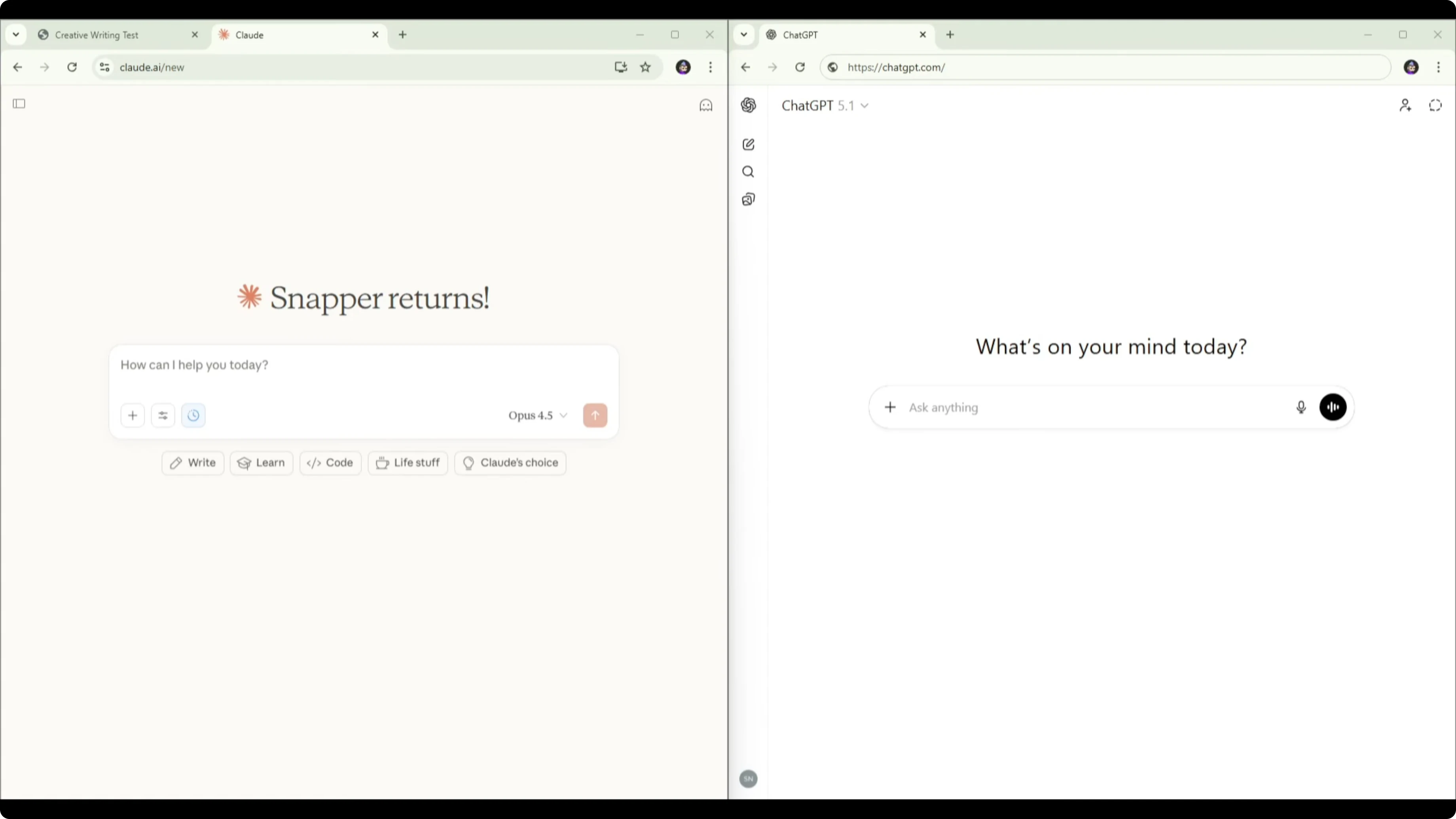
Create a detailed PRD for a community-driven prompt template library web application.

Core features:
- Users can submit prompts with title, description, tags, and AI tool compatibility.
- Users can browse by category, search, and filter by AI tool.
- Voting system with upvote and downvote.
- Download prompts, copy to clipboard, and save to personal collections.
- User profiles with contributions, favorites, and reputation.
- Moderation tools and reporting.
- Analytics for views, downloads, and votes.

Include:
- Problem statement, goals, non-goals
- User personas and user stories
- Information architecture and data models
- Feature list with acceptance criteria
- UX flows for key actions
- Technical stack and APIs
- Security, privacy, and compliance
- Success metrics and rollout plan
- Risks and mitigations
- Appendix with glossary

Output as a well-structured markdown file.
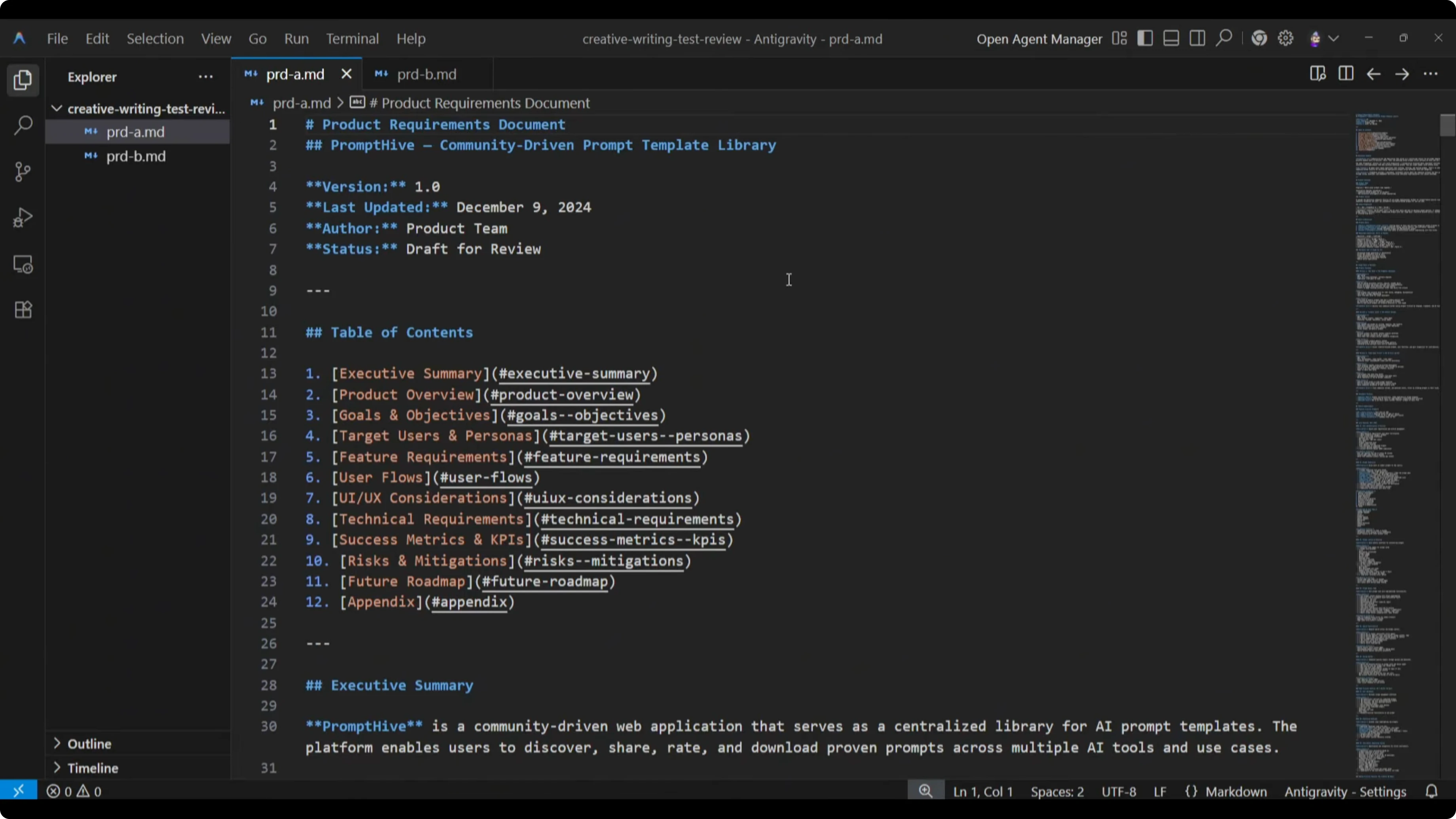
Both models completed the task and produced PRDs. Opus 4.5 produced a far more detailed document with 12 sections in the table of contents. The Opus 4.5 markdown totaled 984 lines, while the GPT-5.1 version was 145 lines.
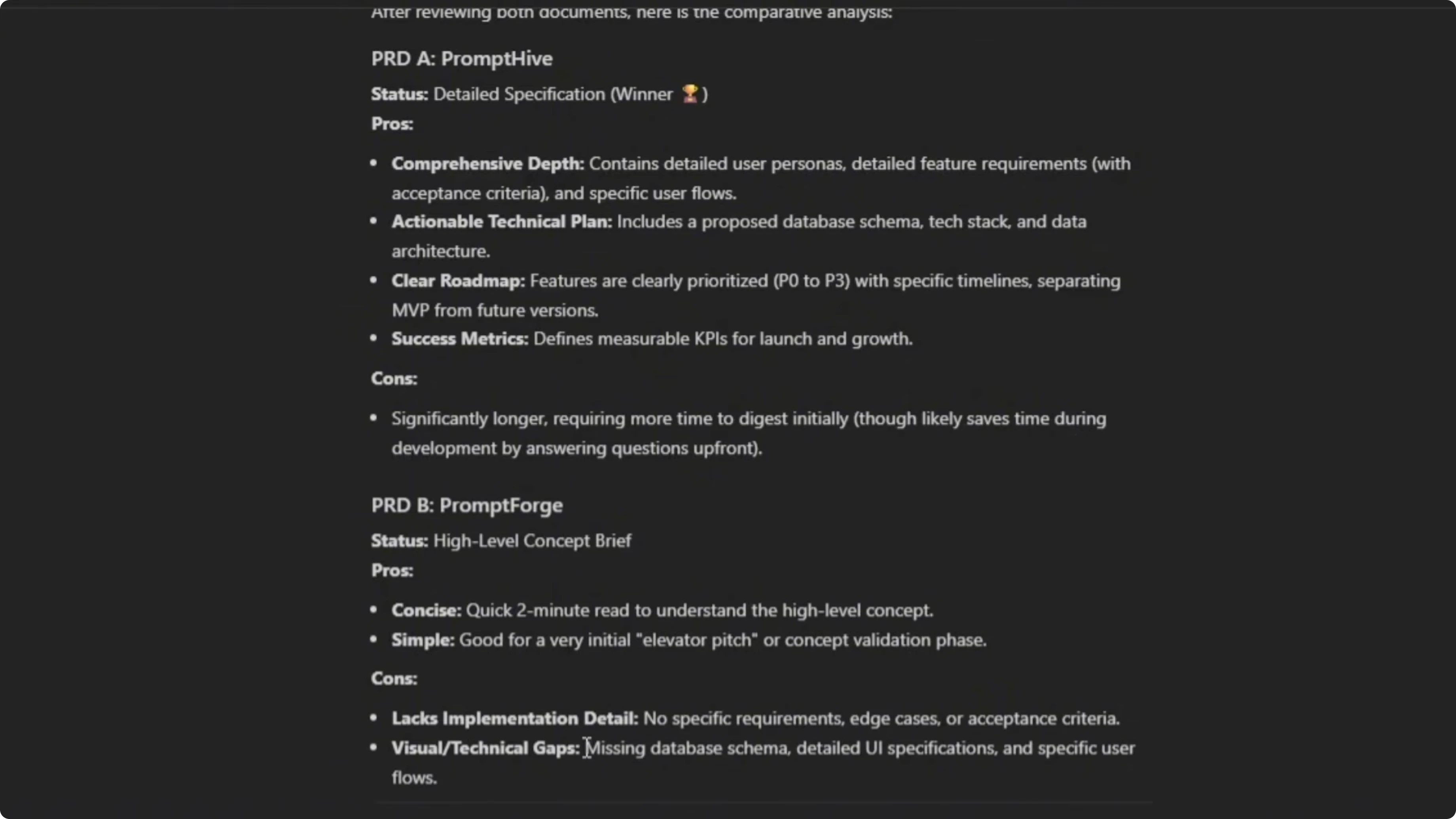
Gemini 3 Pro judged PRDA, the Opus 4.5 version, as the clear winner. It highlighted comprehensive depth, an actionable technical plan, a clear roadmap, and success metrics. The only con was length, but that likely saves time during development by answering questions up front.
PRDB, the GPT-5.1 version, was concise and good for an initial elevator pitch or concept validation. The cons were lack of implementation detail and visible technical gaps. The summary was direct: the Opus 4.5 PRD is production ready and a dev team could start building with minimal ambiguity.
For planning projects with strict budgets, token usage can matter as much as quality. If you are comparing expense profiles, review this token costs comparison.
Opus 4.5 vs GPT-5.1: Which Copywriting Tool Wins - three-email sequence
I tested persuasive narrative, tone, flow, and calls to action aimed at conversions. I asked both models to write a three-email sequence for a waitlist audience using the winning PRD as context. The goal was to build excitement, explain value, and drive signups at launch.
Using the PRD as context, write a three-email sequence to promote the launch.
Audience:
- People who signed up to a waitlist
- Busy developers who skim emails
Goals:
- Build anticipation
- Announce launch
- Convert non-openers with social proof and urgency
Emails:
1) It’s coming - teaser to build anticipation
2) We’re live - launch announcement
3) Don’t miss out - follow-up for non-openers with social proof and urgency
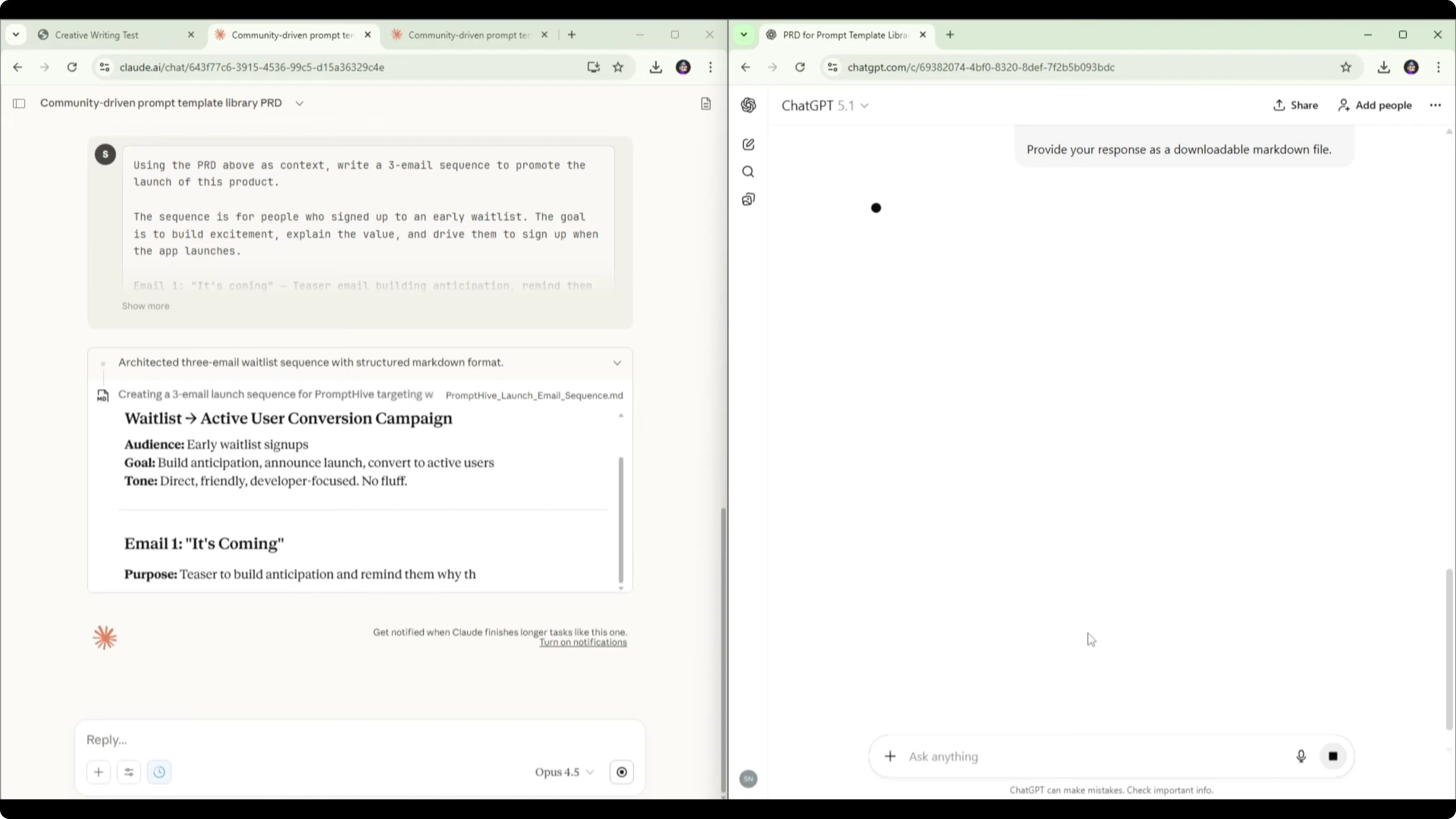
For each email include:
- Subject line
- Preview text
- Body copy
- Call to action
Tone:
- Direct, friendly, not salesy
Output:
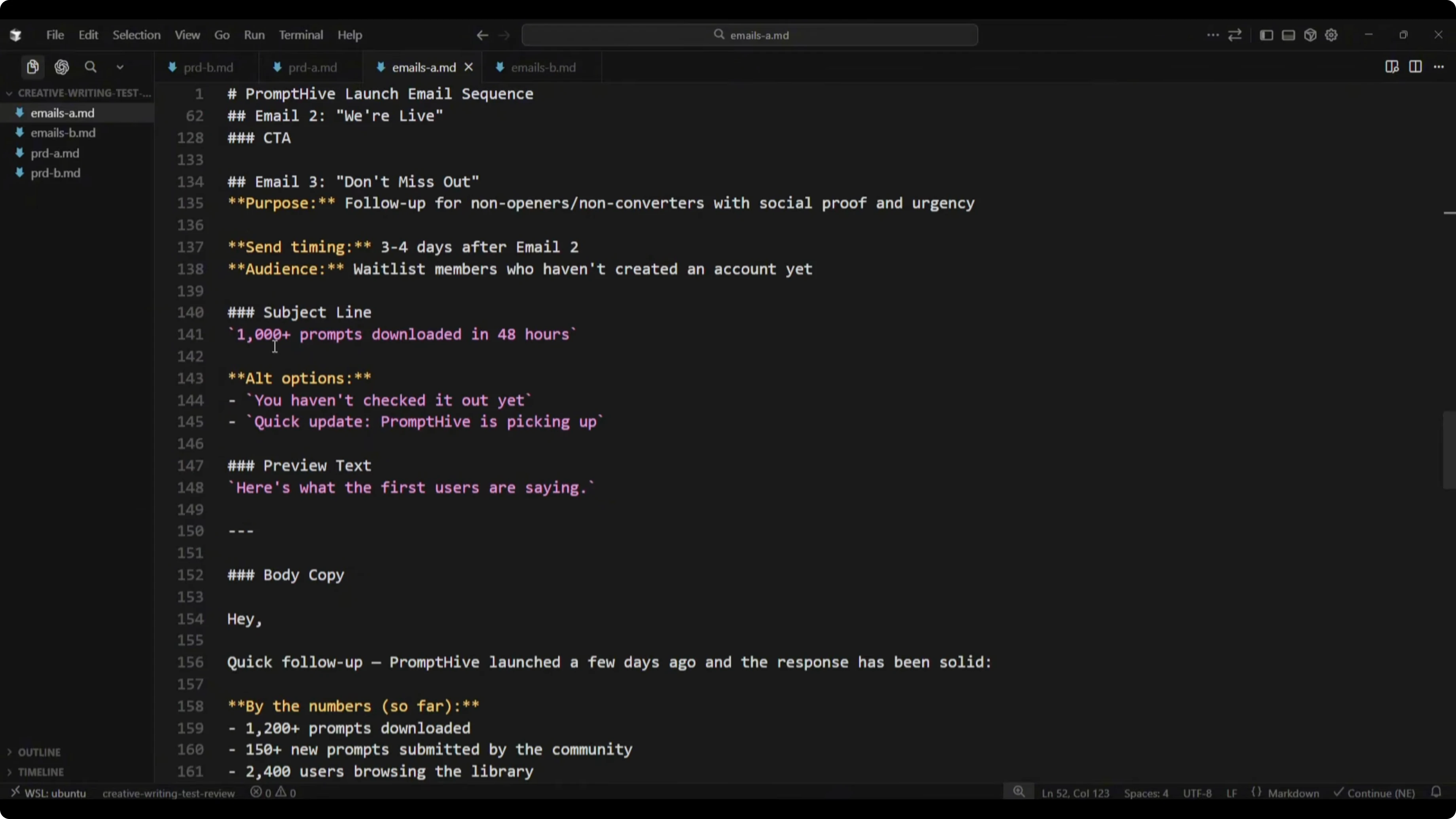
- A downloadable markdown fileAgain, the Opus 4.5 version was a lot more detailed. Email one used a subject line like Your prompts are about to get an upgrade and closed with a smart PS: Got a prompt you’re proud of? Reply to this email. We’re featuring top submissions from waitlist members at launch.
Email three led with 1,000 plus prompts downloaded in 48 hours, then backed it up with specific stats like 1,200 prompts downloaded to drive urgency. It also included a sequence summary, A/B testing recommendations, and metrics to track. The copy read like a professional campaign.
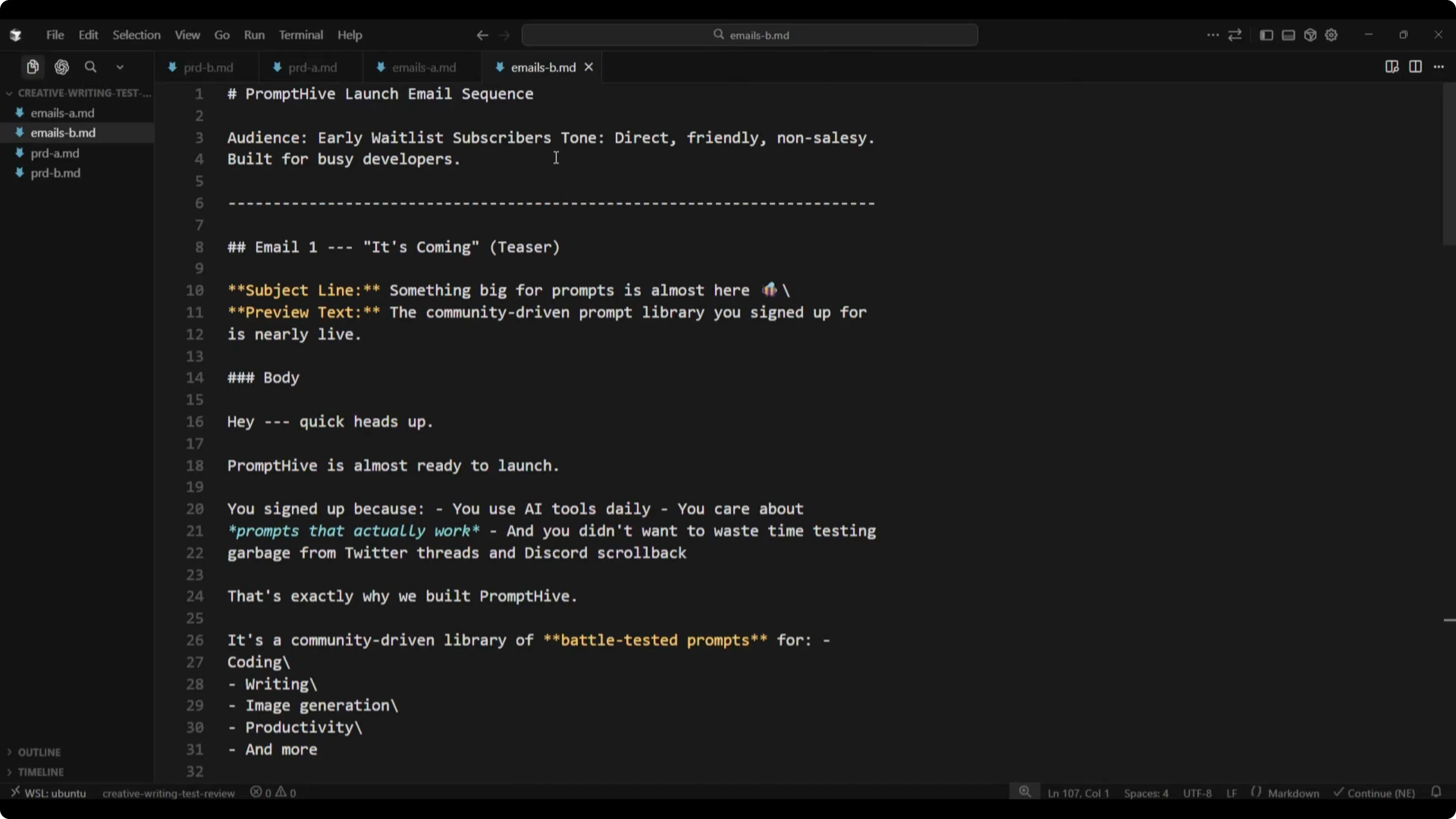
GPT-5.1’s email one used a subject like Something big for prompts is almost here and opened with Hey, quick heads up. It acknowledged the audience well, but the CTA said You’re already on the list. Stand by. It missed the chance to engage with a concrete action.
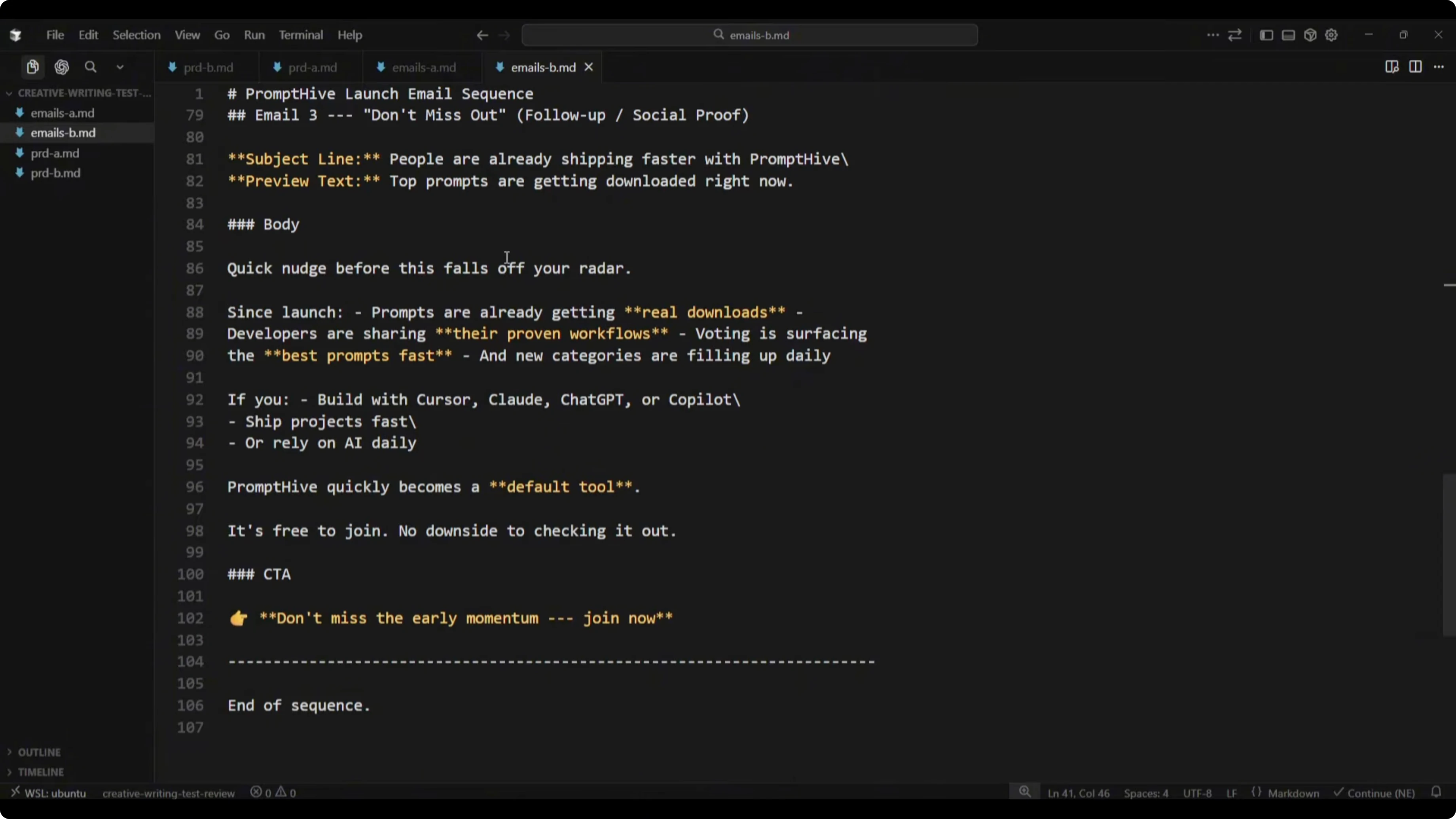
Email three for GPT-5.1 used People are already shipping faster with PromptHive and the CTA Don’t miss the early momentum. Join now. It was functional, but it felt generic next to Opus 4.5.
Gemini 3 Pro picked Opus 4.5 again. It called out a more compelling narrative, stronger psychological hooks, better use of scarcity and social proof, and a more strategic layout. The note was simple: if you are worried about length, trim 10 to 20 percent, but use the Opus 4.5 version.
If you care about writing quality, speed, and cost tradeoffs across models beyond this matchup, see this speed, cost, and quality comparison.
Opus 4.5 vs GPT-5.1: Which Copywriting Tool Wins - landing page copy
The last test was a coming soon expression of interest page to capture intent and learn what potential users want. I included a hero, value prop, the EOI form, and a closing section. Tone guidance was concise and developer friendly.
Using the PRD as context, write copy for a “coming soon” expression of interest landing page.

Include:
- Hero section with headline, subhead, primary CTA
- Value proposition section for developer creators
- Expression of interest form copy (headline, fields, privacy note)
- Closing section with reassurance and social proof hooks

Tone:
- Direct, clear, developer friendly
- Anti-hype, high signal

Output:
- A structured copy deck in markdown
Opus 4.5 delivered a detailed copy deck with multiple headline routes. The primary headline was The prompt library that doesn’t exist yet, with alternatives like Community-tested prompts, one place. The subhead read A community-driven library where the best AI prompts rise to the top. Search, download, contribute. Launching soon.
The value prop section was fully written, the form copy was crisp, and it even added A/B testing suggestions and SEO metadata. GPT-5.1 mirrored the layout but was lighter on detail. Opus 4.5 also included a more complete footer concept and testing notes.
Gemini 3 Pro selected Opus 4.5 again. It said the headline strategy creates immediate intrigue and implies existing solutions are broken, which resonates with this audience. The only con was that the headline is slightly abstract, which for a vibe coder audience can be a feature, not a bug.
If you are comparing Opus variants for similar writing tasks, this breakdown of Opus 4.6 vs Opus 4.5 is helpful: Opus family comparison.
Opus 4.5 vs GPT-5.1: Which Copywriting Tool Wins - comparison overview
| Task | Winner | Why it won | Notable notes |
|---|---|---|---|
| PRD | Opus 4.5 | Comprehensive depth, actionable plan, clear roadmap, success metrics | 984 lines vs 145 lines. Longer to read but saves time later. |
| Three-email launch sequence | Opus 4.5 | Strong narrative, specific hooks, better CTAs, strategic layout | Add PS engagement and A/B ideas. Trim length if needed. |
| Landing page copy | Opus 4.5 | Premium feel for developer creators, strong hook, complete structure | Headline slightly abstract but on-target for the audience. |
If your work is closer to code-centric prompting and tool integration, see this focused look at GPT-5.2 Codex vs Opus 4.5 for practical tradeoffs.
Opus 4.5 vs GPT-5.1: Which Copywriting Tool Wins - pros and cons
Opus 4.5 vs GPT-5.1: Which Copywriting Tool Wins - Opus 4.5
Pros: It consistently produces production-ready documents with full technical detail. It writes persuasive copy with strong hooks, concrete CTAs, and smart extras like A/B tests and metrics. It feels tailored to developer creators with an anti-hype, high-signal tone.
Cons: It runs long and requires trimming for speed-focused teams. Abstract headlines may need testing before launch. Expect more text to review on each pass.
Opus 4.5 vs GPT-5.1: Which Copywriting Tool Wins - GPT-5.1
Pros: It is concise and fast to read, which can help in early concept validation. It can outline the high level well and keep things moving. Short drafts make stakeholder alignment quicker in the first pass.
Cons: It often lacks implementation detail and specificity. CTAs can be generic or underused. You will likely need multiple follow-ups to reach a production-ready state.
For more context across GPT and Opus in broader workloads, this analysis adds nuance: speed-cost-quality tradeoffs.
Opus 4.5 vs GPT-5.1: Which Copywriting Tool Wins - use cases
Opus 4.5 is ideal for PRDs that a dev team can pick up and build from with minimal clarification. It shines in conversion-focused copy like launch emails and landing pages, where specificity, social proof, and testing notes matter. Use it when you want one prompt to get you most of the way there.
GPT-5.1 is a good choice for fast ideation, early outlines, and stakeholder previews. It works when you need a short read to align on direction before deepening detail. Use it as a quick first pass, then expand.
If you are weighing tradeoffs across more than these two, this broader head-to-head is useful reading: multi-vendor comparison.
Opus 4.5 vs GPT-5.1: Which Copywriting Tool Wins - reproduce the test
Gather three prompts covering a PRD, a three-email sequence, and a pre-launch landing page.
Keep the PRD prompt open but structured with sections, data models, and acceptance criteria.
Run both models with the same PRD brief and save the markdown outputs.
Label outputs PRDA and PRDB without model names.
Feed both PRDs into Gemini 3 Pro and ask it to score clarity, completeness, and production readiness.
Pick the winning PRD and use it as shared context for both models for the email and landing page tasks.
Run the email sequence prompt for both models with the shared PRD context.
Collect outputs, anonymize as version A and B, then ask Gemini 3 Pro to score narrative, hooks, CTAs, and conversion focus.
Repeat for the landing page prompt and score headline strength, value framing, form copy, and completeness.
Aggregate the judge’s verdict across all tasks.
Note qualitative differences like A/B testing suggestions, SEO metadata, and specificity.
Declare the overall winner and trim the chosen copy by 10 to 20 percent if needed for brevity.
Final thoughts
Across all three tasks, Opus 4.5 won on depth, specificity, and conversion thinking. It consistently produced documents a team could ship with fewer clarification loops. GPT-5.1 was concise and useful for early reads, but it needed more prompts to reach production-ready quality.
If your priority is strong first-pass outputs that feel ready for handoff, pick Opus 4.5. If you want rapid outlines for early alignment, pick GPT-5.1 and plan for follow-ups. For adjacent comparisons that may sway your choice in edge cases, this review of GPT-5.2 Codex vs Opus 4.5 and this token cost breakdown can help refine the decision.
Subscribe to our newsletter
Get the latest updates and articles directly in your inbox.

Related Posts
8 Best Claude Code Plugins in 2026 (You Need to Know)
8 Best Claude Code Plugins in 2026 (You Need to Know)
7 Best Claude Code Skills (You Need to Know)
7 Best Claude Code Skills (You Need to Know)
Claude Code Desktop IDE Features (You Need to Know)
Claude Code Desktop IDE Features (You Need to Know)