
Table Of Content
- OpenClaw vs Hermes Agent: Which Fits Your Needs Best?
- Architecture shapes everything
- Memory and learning are the biggest split
- Plugin depth and extensibility
- Model support parity
- Messaging platforms and services
- Multi-agent capabilities
- Security posture
- Installation and setup
- Context management
- Scheduled automation
- Scores and the twist that changes them
- Features breakdown - OpenClaw vs Hermes Agent: Which Fits Your Needs Best?
- OpenClaw features
- Hermes Agent features
- Pros and Cons - OpenClaw vs Hermes Agent: Which Fits Your Needs Best?
- OpenClaw - Pros
- OpenClaw - Cons
- Hermes Agent - Pros
- Hermes Agent - Cons
- Use cases - OpenClaw vs Hermes Agent: Which Fits Your Needs Best?
- Where OpenClaw excels
- Where Hermes Agent excels
- Step-by-step getting started - OpenClaw vs Hermes Agent: Which Fits Your Needs Best?
- OpenClaw quick start
- Hermes Agent quick start
- Final Conclusion - OpenClaw vs Hermes Agent: Which Fits Your Needs Best?
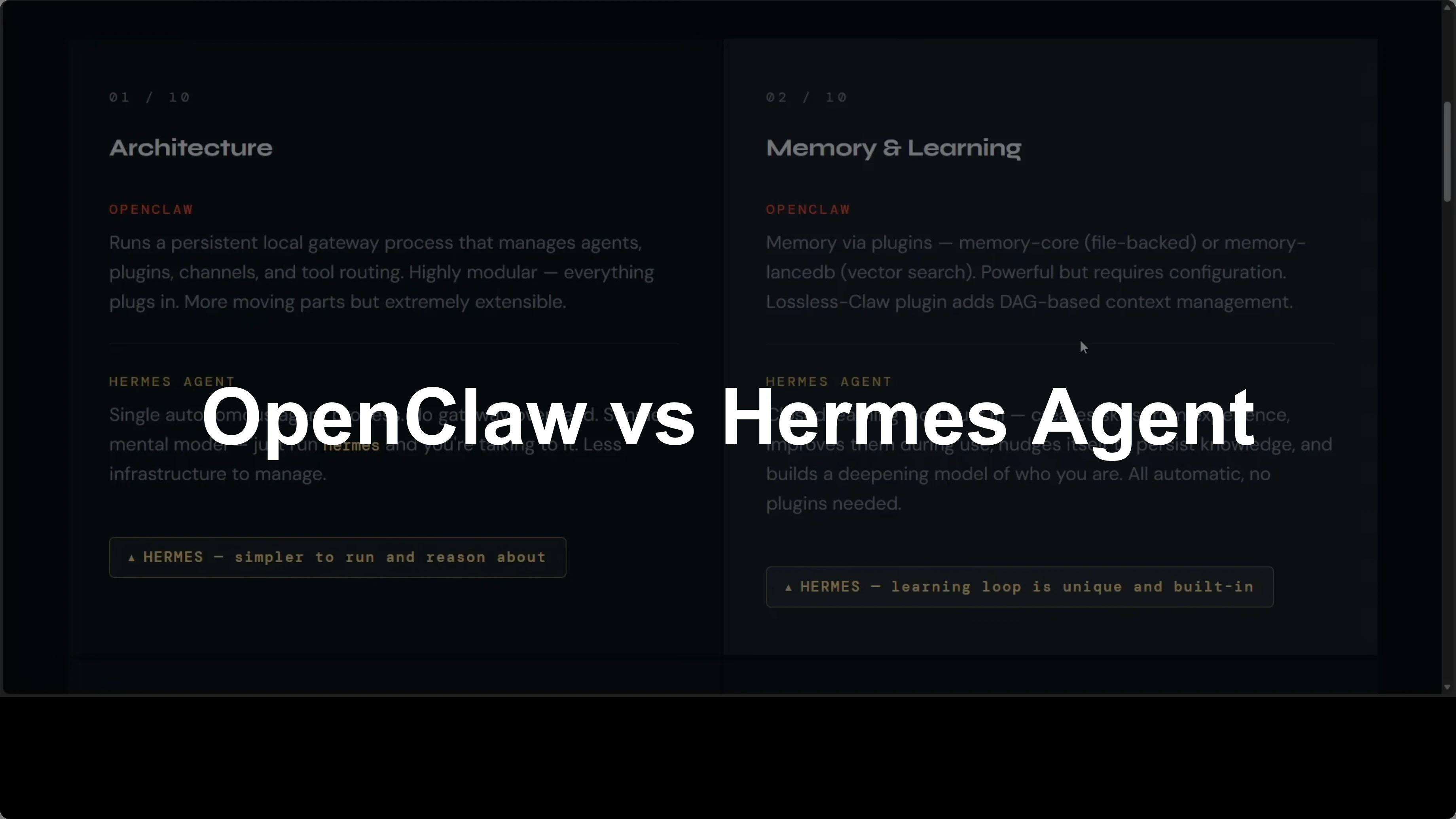
OpenClaw vs Hermes Agent: Which Fits Your Needs Best?
OpenClaw Error Fixer
Paste any OpenClaw error and get the exact fix instantly — cause, steps, copy-ready commands, and related guides.
Table Of Content
- OpenClaw vs Hermes Agent: Which Fits Your Needs Best?
- Architecture shapes everything
- Memory and learning are the biggest split
- Plugin depth and extensibility
- Model support parity
- Messaging platforms and services
- Multi-agent capabilities
- Security posture
- Installation and setup
- Context management
- Scheduled automation
- Scores and the twist that changes them
- Features breakdown - OpenClaw vs Hermes Agent: Which Fits Your Needs Best?
- OpenClaw features
- Hermes Agent features
- Pros and Cons - OpenClaw vs Hermes Agent: Which Fits Your Needs Best?
- OpenClaw - Pros
- OpenClaw - Cons
- Hermes Agent - Pros
- Hermes Agent - Cons
- Use cases - OpenClaw vs Hermes Agent: Which Fits Your Needs Best?
- Where OpenClaw excels
- Where Hermes Agent excels
- Step-by-step getting started - OpenClaw vs Hermes Agent: Which Fits Your Needs Best?
- OpenClaw quick start
- Hermes Agent quick start
- Final Conclusion - OpenClaw vs Hermes Agent: Which Fits Your Needs Best?
You have seen OpenClaw and you have seen Hermes Agent, both running locally and both connected to Telegram. But which one should you actually use for your own use case? I put them head-to-head across 10 categories, pick a winner for each, and at the end reveal something that changes the score line.
Before we begin, a quick setup. OpenClaw is the open-source AI agentic platform built around a modular gateway, plugins, channels, tool routing, the whole ecosystem. Hermes Agent is built by N Research, the lab behind capable open-source models, and it is a single autonomous agent with a built-in learning loop.
When I score OpenClaw in this comparison, I am scoring the full ecosystem. That means OpenClaw plus LosslessClaw for context management, NemoClaw for sandboxed execution, and HighClaw for multi-agent coordination. Multiple tools against one, and I come back to what that means at the end.
If you want a local setup walkthrough and practical pointers, check out this OpenClaw local agent guide.
| Category | OpenClaw (ecosystem) | Hermes Agent | Winner |
|---|---|---|---|
| Architecture | Persistent gateway with modular plugins, channels, and tool routing | Single process, type hermes and you are talking to it | Hermes |
| Memory and learning | Plugin-based memory plus LosslessClaw context engine if added | Built-in learning loop, auto skill creation, auto memory saving | Hermes |
| Plugin and extensibility | Deep ecosystem, ClawHub community plugins, NemoClaw, HighClaw, LosslessClaw | 94 bundled skills, agent creates new skills from experience | OpenClaw |
| Model support | Ollama, VLMs, OpenRouter, Anthropic, OpenAI, custom endpoints | Ollama, VLMs, OpenRouter, Anthropic, OpenAI, custom endpoints | Tie |
| Messaging platforms | Telegram, WhatsApp, Slack, Signal, Matrix, systemd services | Telegram, WhatsApp, Slack, Signal, Matrix, systemd services | Tie |
| Multi-agent capabilities | HighClaw gives a full multi-agent OS with Matrix chat rooms and credential isolation | Sub agent delegation with isolated terminals | OpenClaw |
| Security | NemoClaw with OpenShell, Landlock, seccomp, network namespace, policy layer, HighClaw credential isolation | Approval modes, LLM risk checks, Docker or SSH isolation | OpenClaw |
| Installation and setup | Single curl install, full stack takes time to compose | Single curl install, runs immediately | Hermes |
| Context management | LosslessClaw DAG based, never deletes, SQLite backed | Automatic compression, configurable threshold, separate summarizer | OpenClaw |
| Scheduled automation | Can schedule with a few manual steps | Natural language to cron, no extra configuration | Hermes |
| Overall score | OpenClaw ecosystem 5.5 | Hermes Agent 6 | Hermes |
| Core-only note | Strip extras and compare core OpenClaw vs Hermes | Hermes wins 7 to 3 | Hermes |
OpenClaw vs Hermes Agent: Which Fits Your Needs Best?
Architecture shapes everything
OpenClaw runs a persistent gateway on your machine. It manages agents, plugins, channels, and tool routing. The upside is modularity, the downside is more moving parts to manage.
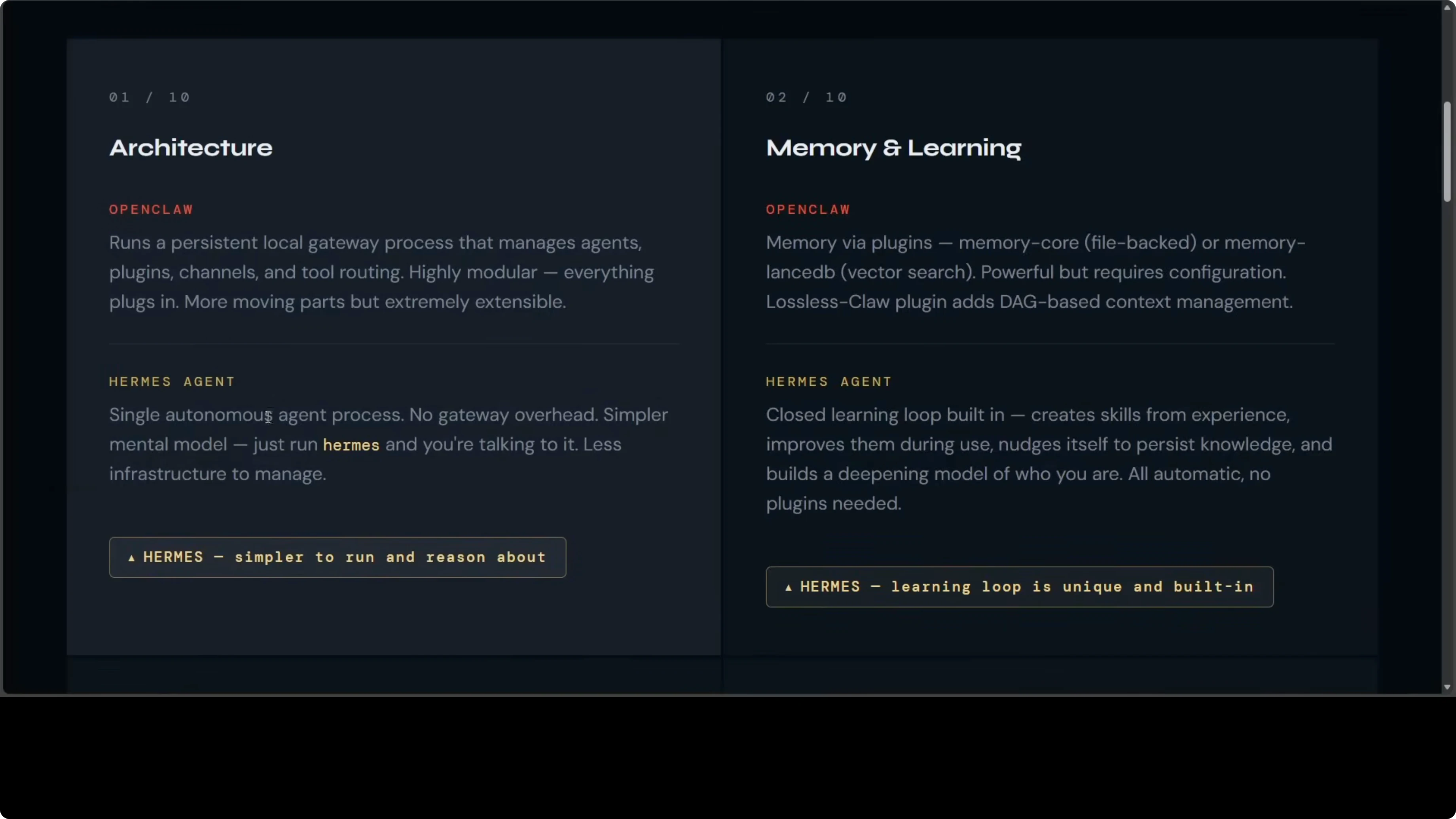
Hermes Agent is the opposite. It is a single process. You type hermes and you are talking to it, with no gateway to think about and no separate background process.
Winner in my opinion is Hermes.
Memory and learning are the biggest split
OpenClaw has a solid memory system through plugins. You get file-backed memory, LanceDB vector search with auto recall, and with LosslessClaw a DAG based context engine that preserves every message and lets the agent drill back into history. It is impressive, but you install and configure these parts.
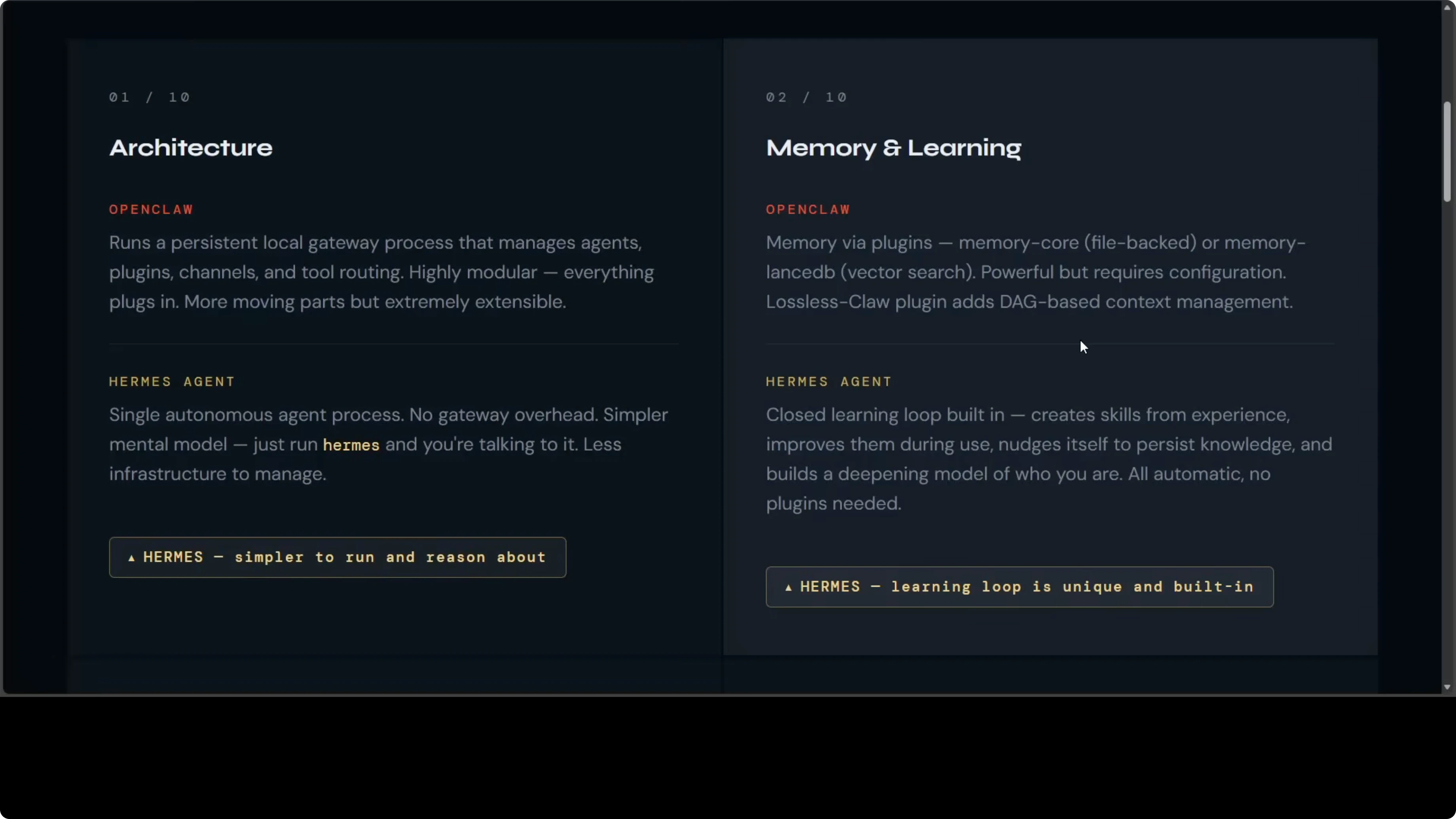
Hermes takes a completely different approach. The learning loop is built directly into the agent. It creates skills from what it does, improves them during use, nudges itself to save important things to memory, and builds a model of who you are that deepens across every session, all automatically with zero configuration.
Winner clearly is Hermes.
Plugin depth and extensibility
OpenClaw has one of the deepest plugin architectures in the open-source agent space. NemoClaw handles sandboxed secure execution, HighClaw brings full multi-agent coordination, LosslessClaw adds context management, and ClawHub hosts community plugins. It is a proper ecosystem that you can extend in ways the core never anticipated, and developers are building on top of it.
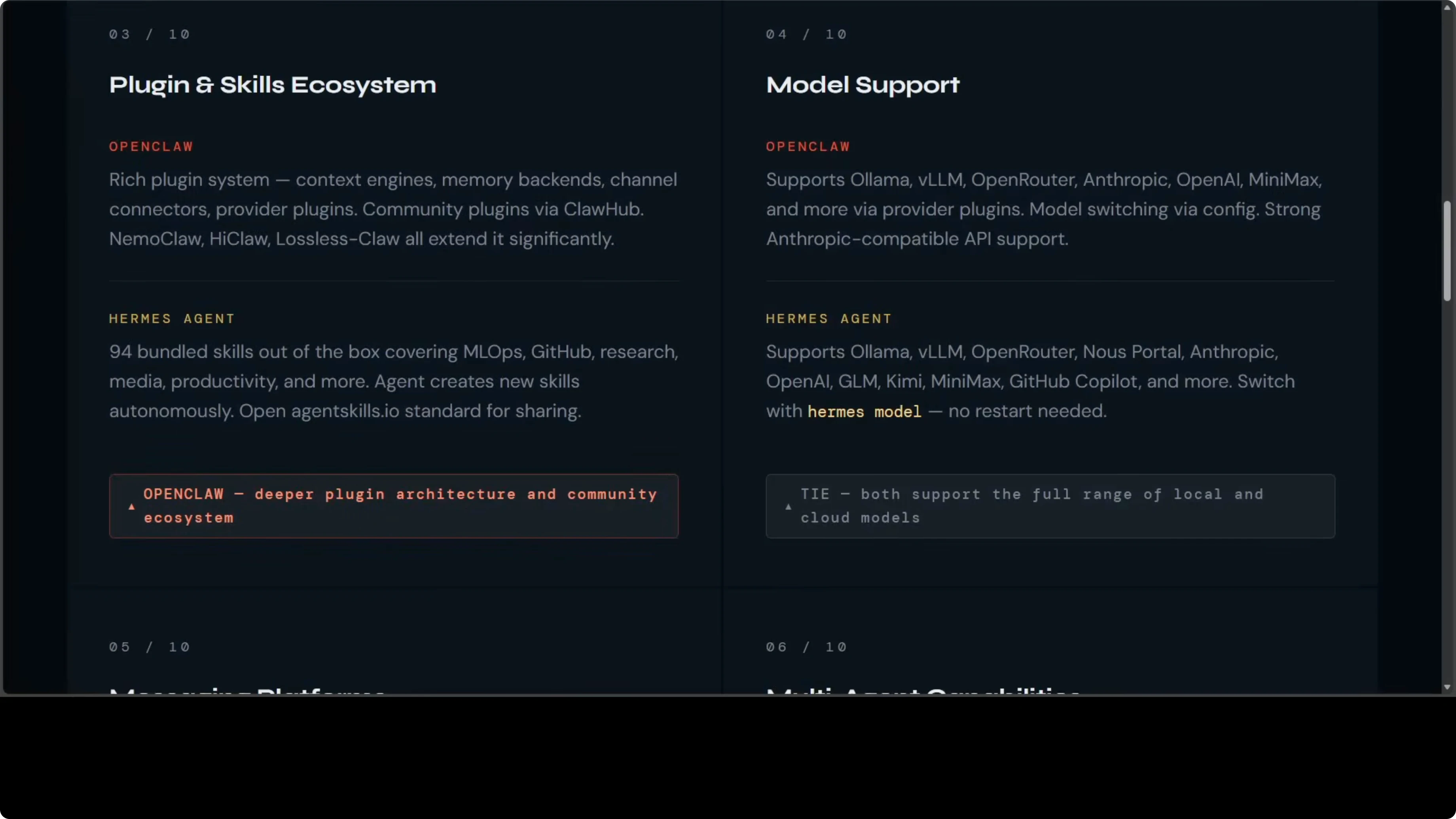
Hermes ships 94 bundled skills out of the box across MLOps, GitHub workflows, research tools, and media productivity. The agent creates new skills autonomously from its own experience. You are working within what is there rather than building on top of a platform.
Very clearly OpenClaw is the winner here. For a broader look at the family of components and variants, see this OpenClaw variants comparison.
Model support parity
Both tools support the full range of local and cloud-based models. Ollama, VLMs, OpenRouter, Anthropic, OpenAI, and custom endpoints are all supported. I have run GLM and Qwen, and both handled them cleanly.
This one is a tie. Both work quite well in terms of model support. There is no practical gap here.
Messaging platforms and services
Both support Telegram, WhatsApp, Slack, Signal, and Matrix. Both run as systemd services so they survive reboots and keep running when you close your terminal. Both deliver notifications and cron outputs to your phone.
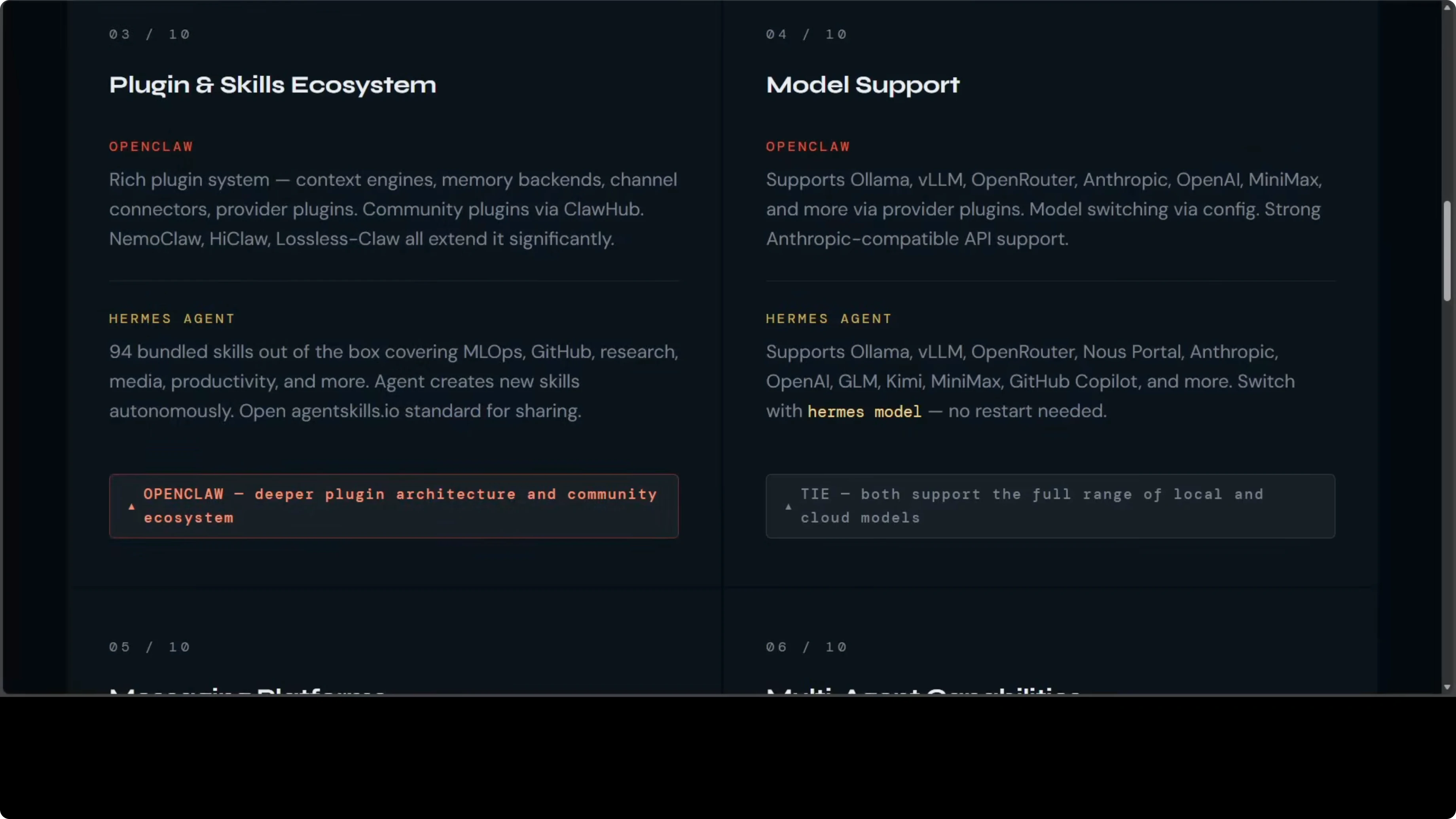
Setup on Telegram is comparable across both. There is no clear advantage for integrations. Another tie here.
If you want a Telegram-first walkthrough with OpenClaw, this short guide to a Memubot OpenClaw agent is a helpful reference.
Multi-agent capabilities
This is where the OpenClaw ecosystem pulls away. HighClaw gives you a full multi-agent operating system with a manager that spins up worker agents through Matrix chat rooms. You can watch every agent conversation in real time, jump in whenever you want, and real credentials never leave the gateway so workers only see consumer tokens.
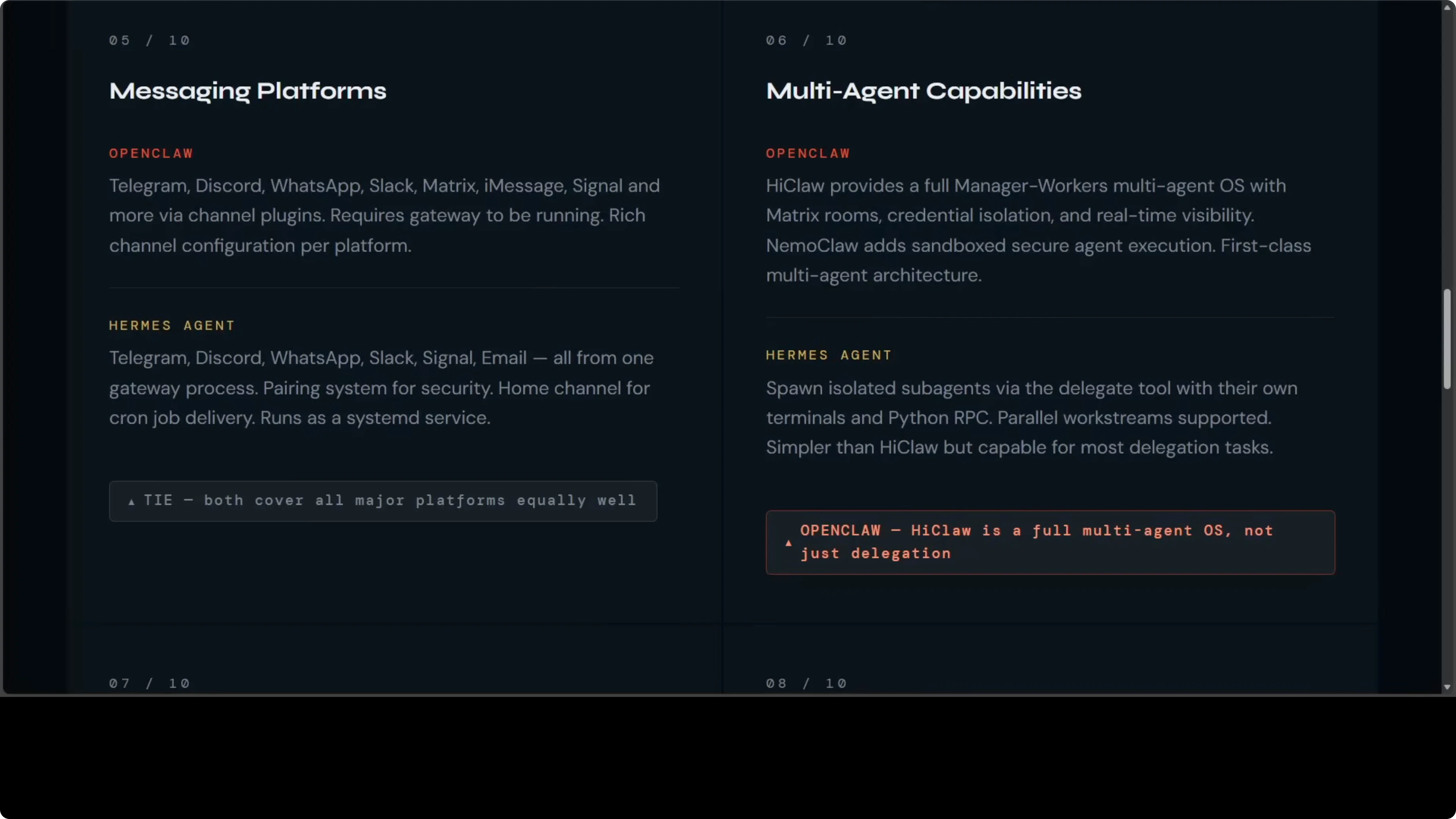
I built a simple to-do app with Ellis handling front end and Bob handling back end, and it worked great. Hermes has sub agent delegation. You can spawn isolated sub agents with their own terminals for parallel work streams, but it is not a full multi-agent operating system.
A clear winner here is OpenClaw.
Security posture
NemoClaw wraps your agent inside OpenShell. That is Landlock, seccomp, and a network namespace, with strict file system isolation and controlled network egress, and every inference call routed through a policy layer. HighClaw adds credential isolation so workers never see your real API keys, which is enterprise grade.
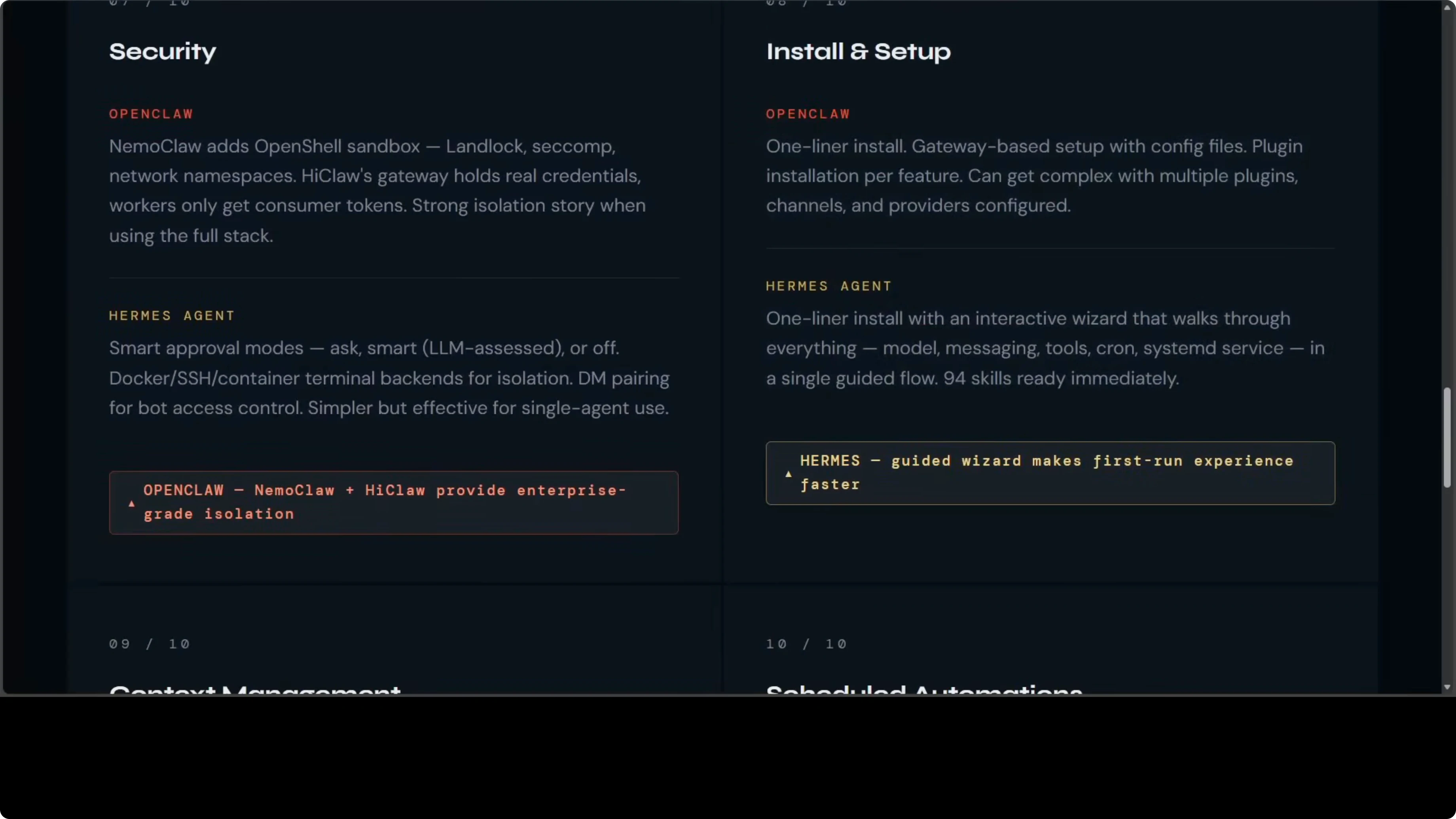
Hermes has smarter approval modes and can ask before running any flagged command or use an LLM to assess risk. You can also run it in Docker or over SSH for container isolation, which is solid for personal use. If you are running agents in a team environment, OpenClaw’s security story with its variants is in a different league.
OpenClaw is the winner in security, and security is still your responsibility.
Installation and setup
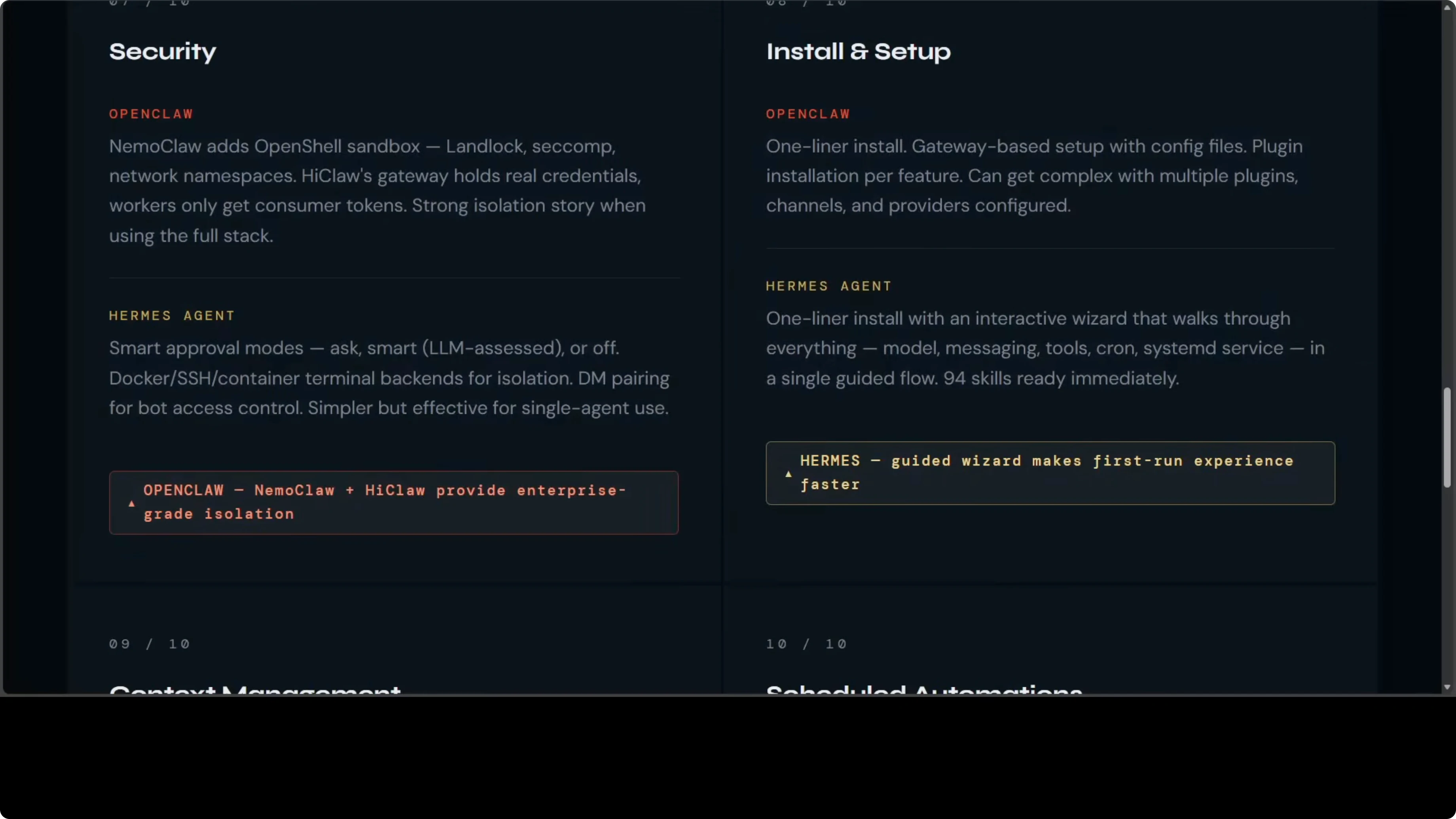
Both install with a single curl command. OpenClaw installs cleanly, but building out the full stack with plugins, channels, and providers takes time and some familiarity. Hermes is a winner in simplicity.
Context management
LosslessClaw brings DAG based hierarchical summarization to OpenClaw. Nothing is ever deleted, every message lives in SQLite, and depth zero summaries capture extractions and decisions, which is the most sophisticated context system I have seen in an open-source agent. Hermes has built-in automatic compression with a configurable threshold and a separate summarization model, and it shows context pressure warnings in the CLI.
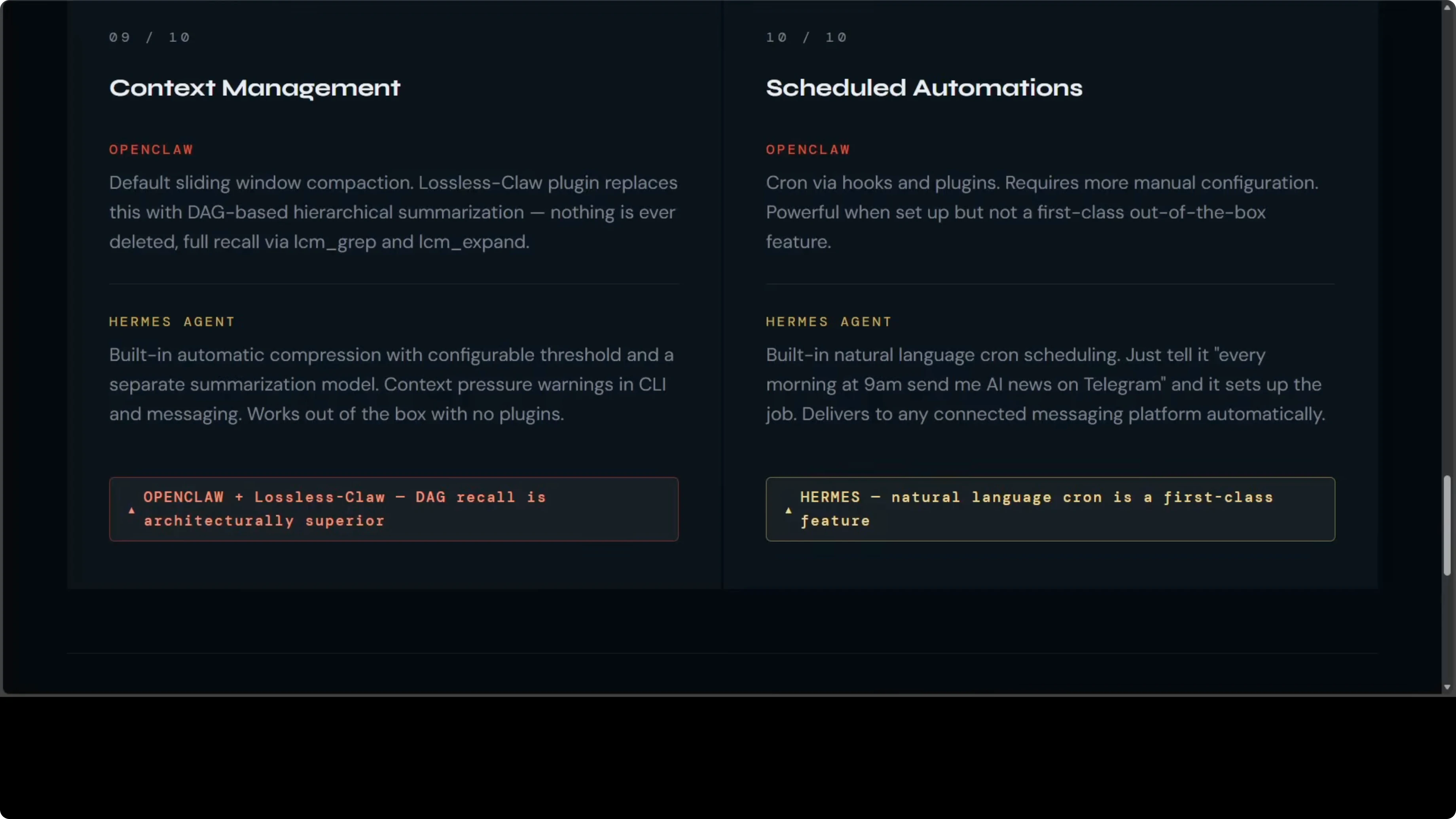
It works cleanly, but it is not lossless. It is standard compaction. OpenClaw with LosslessClaw is the clear winner.
Scheduled automation
This one is straightforward. You tell Hermes in plain English what to run and when, and it sets up the cron job. The job runs on schedule and delivers to your phone, with no extra configuration.
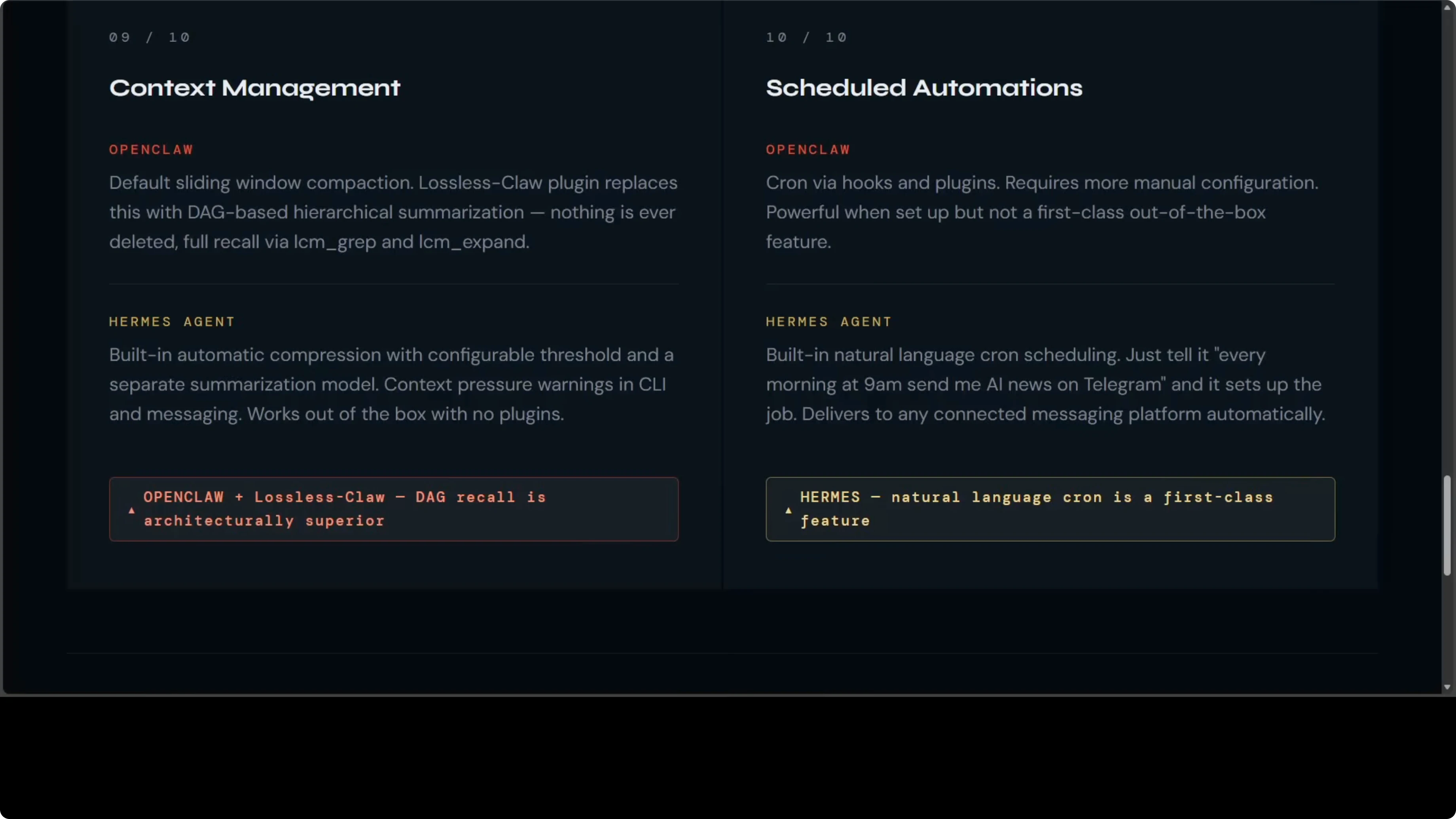
OpenClaw can also handle scheduled tasks, but there are a few manual steps. Hermes is a slight winner here.
Scores and the twist that changes them
OpenClaw ecosystem 5.5, Hermes Agent 6. A close race. Strip away LosslessClaw, NemoClaw, and HighClaw, compare only core OpenClaw against Hermes Agent, and Hermes wins seven categories to three.
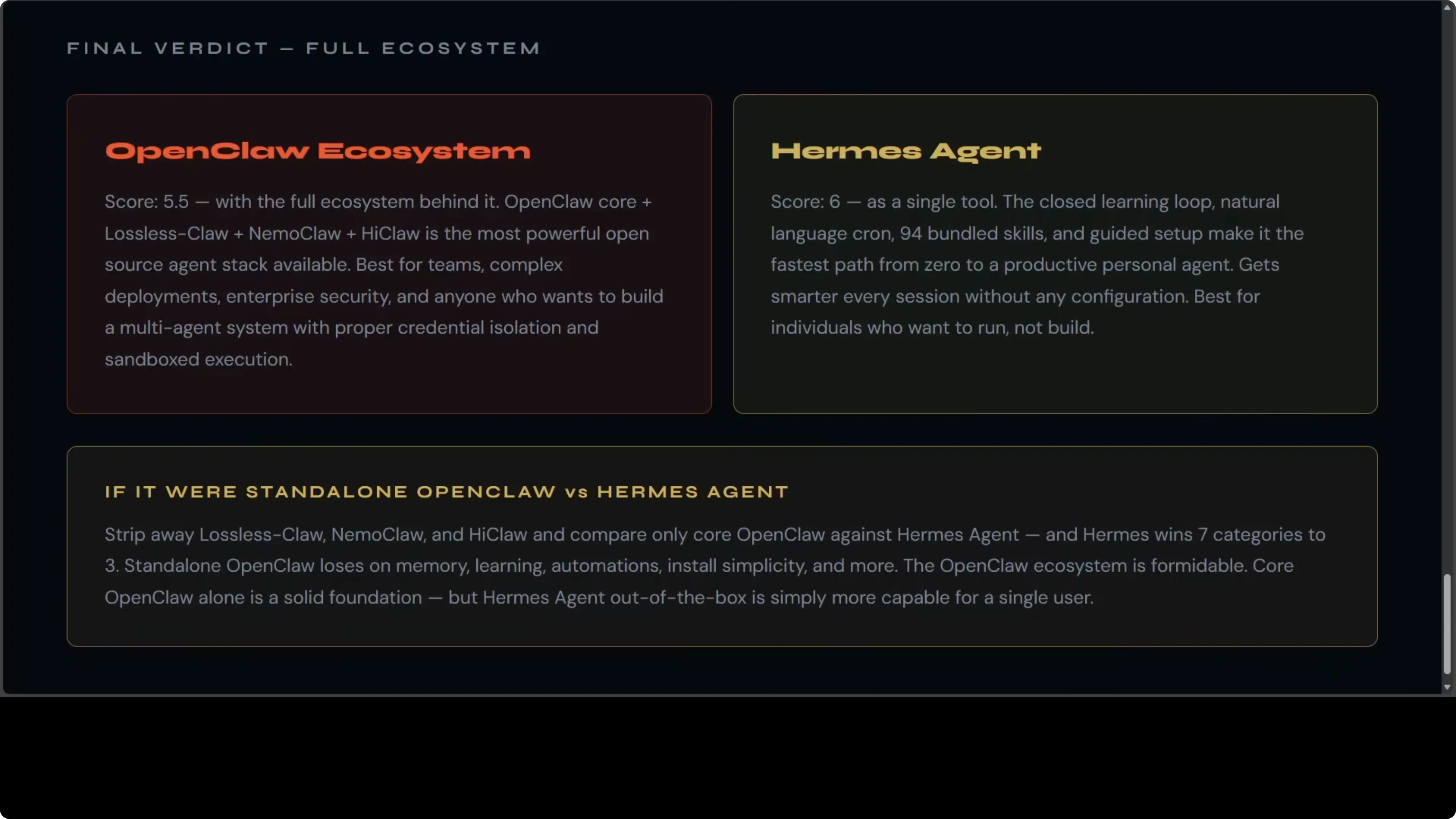
The OpenClaw ecosystem is formidable. Core OpenClaw alone is a solid foundation, but Hermes Agent out of the box is simply more capable for a single user running a personal agent. They are not really competing with each other, they are built for different people.
Features breakdown - OpenClaw vs Hermes Agent: Which Fits Your Needs Best?
OpenClaw features
-
Modular gateway with plugins, channels, and tool routing.
-
LosslessClaw DAG based context engine with SQLite and persistent history.
-
HighClaw multi-agent OS with manager-worker pattern via Matrix rooms.
-
NemoClaw isolation using OpenShell with Landlock, seccomp, and network namespace.
-
ClawHub community plugins and a growing ecosystem.
-
systemd services, Telegram, WhatsApp, Slack, Signal, Matrix integrations.
Explore more OpenClaw walkthroughs and component deep dives in this OpenClaw collection.
Hermes Agent features
-
Single-process agent with a built-in learning loop.
-
Automatic skill creation and continuous self-improvement.
-
Smart memory saves, identity modeling, and session-to-session growth.
-
94 bundled skills across MLOps, GitHub workflows, research, and media productivity.
-
Approval modes for commands with LLM risk assessment.
-
Docker and SSH options for isolation, plus messaging platform support and systemd.
Pros and Cons - OpenClaw vs Hermes Agent: Which Fits Your Needs Best?
OpenClaw - Pros
-
Deep extensibility via plugins and ClawHub.
-
Best-in-class context with LosslessClaw.
-
Full multi-agent orchestration with HighClaw.
-
Strong isolation and policy control with NemoClaw.
-
Broad model and channel support with custom endpoints.
-
Clear credential isolation for team workflows.
OpenClaw - Cons
- More moving parts to manage and configure.
- Full power requires composing variants like LosslessClaw, NemoClaw, and HighClaw.
- Scheduling and some setups need extra manual steps.
Hermes Agent - Pros
-
Install and go simplicity.
-
Built-in learning loop that improves skills automatically.
-
Natural language scheduling to cron with zero extra config.
-
Solid model and channel support with custom endpoints.
-
Helpful approval modes and risk checks for commands.
-
Sub agent delegation for parallel work streams.
Hermes Agent - Cons
- Extensibility does not go as deep as OpenClaw’s ecosystem.
- Context handling is compression based, not lossless.
- Not a full multi-agent operating system.
Use cases - OpenClaw vs Hermes Agent: Which Fits Your Needs Best?
Where OpenClaw excels
- Teams that need multi-agent coordination with a manager spinning up workers.
- Workloads that demand sandboxed execution, policy controls, and credential isolation.
- Custom pipelines that benefit from a modular gateway and community plugins.
Where Hermes Agent excels
- Single users who want an agent that works immediately and learns across sessions.
- Scenarios that benefit from natural language scheduling and bundled skills.
- Users who prefer zero configuration for memory and learning.
For more agent patterns and comparisons, visit our broader agent resources.
Step-by-step getting started - OpenClaw vs Hermes Agent: Which Fits Your Needs Best?
OpenClaw quick start
-
Install OpenClaw with the single-line installer.
-
Start the gateway and confirm it runs as a service or via systemd.
-
Add your models via Ollama or cloud APIs and set custom endpoints if needed.
-
Connect channels like Telegram or Slack and verify notifications.
-
Install plugins from ClawHub for memory, tools, and routing.
-
Add LosslessClaw for persistent context and HighClaw for multi-agent needs.
-
Use NemoClaw when sandboxing and policy controls are required.
-
Test with a small project, then scale to multi-agent flows.
Hermes Agent quick start
-
Install Hermes with the single-line installer.
-
Run hermes to start a session and confirm it responds.
-
Add model keys for OpenAI, Anthropic, or configure Ollama locally.
-
Set approval modes for command execution and tune safety thresholds.
-
Connect Telegram or Slack if you want mobile notifications.
-
Use natural language to create scheduled tasks and let it auto-manage cron.
-
Let the built-in learning loop create and refine skills as you work.
Final Conclusion - OpenClaw vs Hermes Agent: Which Fits Your Needs Best?
OpenClaw ecosystem 5.5 against Hermes Agent 6 is a close race with different strengths. Strip away LosslessClaw, NemoClaw, and HighClaw and Hermes wins 7 categories to 3, which changes how you weigh the decision.
If you want to build multi-agent systems, sandboxed execution, enterprise security, and the deepest plugin ecosystem, OpenClaw is your platform. If you want to run an agent that works immediately, learns from you, and gets smarter every session without touching a config file, Hermes Agent is your answer. Pick the one that matches how you work.
Subscribe to our newsletter
Get the latest updates and articles directly in your inbox.

Related Posts

8 Best Claude Code Plugins in 2026 (You Need to Know)
8 Best Claude Code Plugins in 2026 (You Need to Know)
7 Best Claude Code Skills (You Need to Know)
7 Best Claude Code Skills (You Need to Know)
Claude Code Desktop IDE Features (You Need to Know)
Claude Code Desktop IDE Features (You Need to Know)